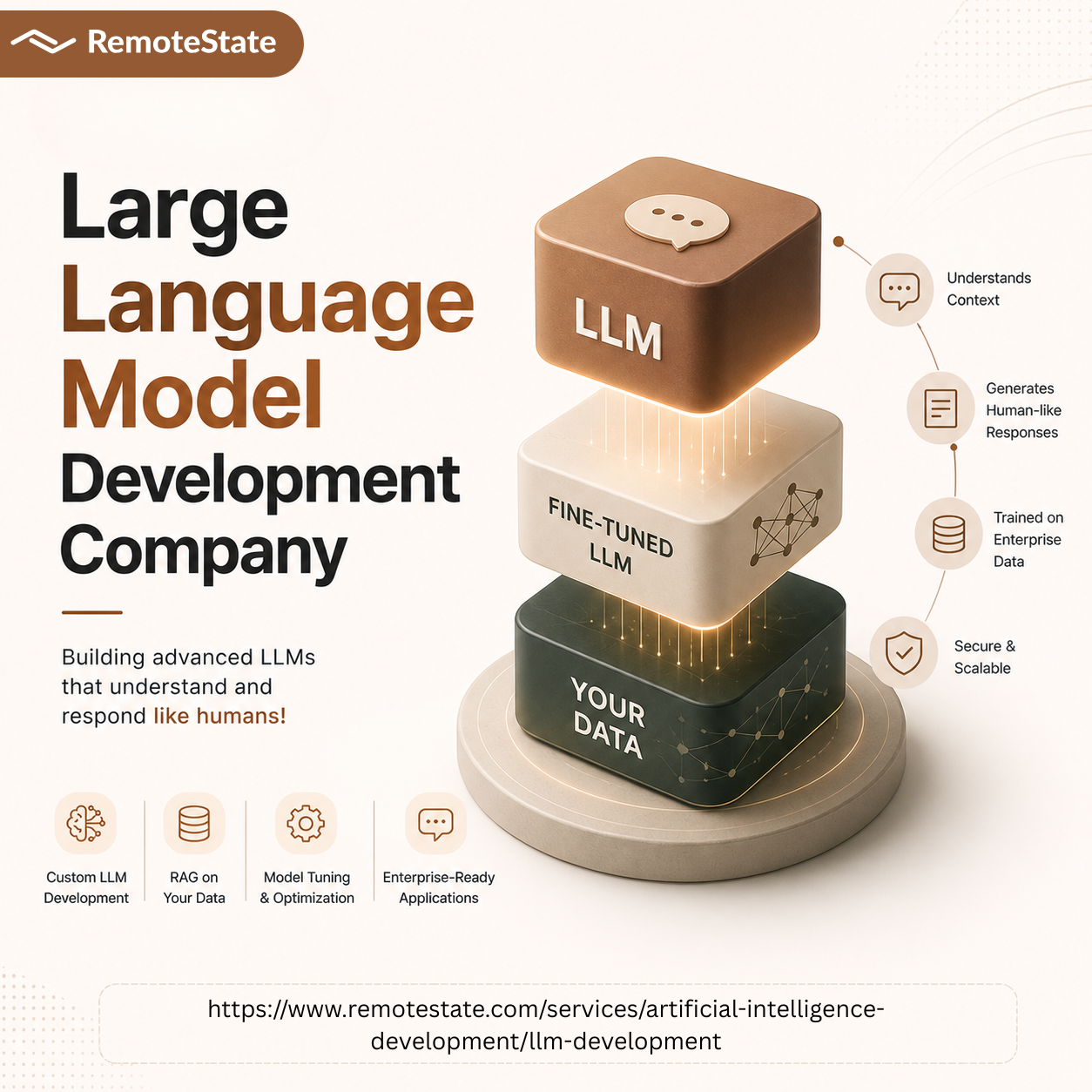
• Leading LLM Development Company for Custom AI Language Solutions
    LLM development company delivering advanced large language models tailored to your business. Build, fine-tune, and deploy secure, scalable AI solutions using enterprise data, RAG pipelines, and model optimization to generate human-like responses and drive intelligent automation. Visit us: https://www.remotestate.com/services/artificial-intelligence-development/llm-development
    Leading LLM Development Company for Custom AI Language Solutions LLM development company delivering advanced large language models tailored to your business. Build, fine-tune, and deploy secure, scalable AI solutions using enterprise data, RAG pipelines, and model optimization to generate human-like responses and drive intelligent automation. Visit us: https://www.remotestate.com/services/artificial-intelligence-development/llm-development
    0 التعليقات 0 المشاركات 2كيلو بايت مشاهدة 0 معاينة
  • The rise of large language models (LLMs) is rapidly transforming the landscape of software development. These powerful AI systems are moving beyond mere text generation and are increasingly being leveraged for tasks that were once exclusive to human developers. Code completion is perhaps the most established application, with tools like GitHub Copilot already demonstrating significant productivity gains by suggesting lines or even entire functions of code based on context. This allows developers to focus on higher-level problem-solving and architectural design, rather than getting bogged down in repetitive coding tasks.

    Beyond simple completion, LLMs are showing promise in areas like code translation and refactoring. Imagine needing to port a legacy application from COBOL to Python, or to optimize a performance-critical section of Java code. LLMs can analyze existing code, understand its logic, and generate equivalent or improved code in a target language, significantly reducing the manual effort and potential for human error involved in these complex processes. This capability opens doors for modernizing older systems and improving the efficiency of existing codebases.

    Furthermore, LLMs are starting to impact the realm of testing and debugging. They can generate unit tests based on code descriptions or existing tests, ensuring better code coverage and identifying potential edge cases that might be overlooked. For debugging, LLMs can analyze error messages, stack traces, and code snippets to pinpoint the root cause of bugs and even suggest potential fixes. This proactive approach to quality assurance can dramatically shorten development cycles and improve software reliability.

    However, embracing LLMs in software engineering is not without its challenges. Ensuring the accuracy and security of generated code is paramount. LLMs can sometimes produce code with subtle bugs or security vulnerabilities, requiring diligent human review and robust testing practices. The ethical implications of AI-generated code, such as intellectual property concerns and potential job displacement, also warrant careful consideration as these technologies mature and become more integrated into development workflows. The future of software engineering likely involves a symbiotic relationship between human developers and AI assistants, where each leverages their unique strengths to build better software, faster and more efficiently.
    The rise of large language models (LLMs) is rapidly transforming the landscape of software development. These powerful AI systems are moving beyond mere text generation and are increasingly being leveraged for tasks that were once exclusive to human developers. Code completion is perhaps the most established application, with tools like GitHub Copilot already demonstrating significant productivity gains by suggesting lines or even entire functions of code based on context. This allows developers to focus on higher-level problem-solving and architectural design, rather than getting bogged down in repetitive coding tasks. Beyond simple completion, LLMs are showing promise in areas like code translation and refactoring. Imagine needing to port a legacy application from COBOL to Python, or to optimize a performance-critical section of Java code. LLMs can analyze existing code, understand its logic, and generate equivalent or improved code in a target language, significantly reducing the manual effort and potential for human error involved in these complex processes. This capability opens doors for modernizing older systems and improving the efficiency of existing codebases. Furthermore, LLMs are starting to impact the realm of testing and debugging. They can generate unit tests based on code descriptions or existing tests, ensuring better code coverage and identifying potential edge cases that might be overlooked. For debugging, LLMs can analyze error messages, stack traces, and code snippets to pinpoint the root cause of bugs and even suggest potential fixes. This proactive approach to quality assurance can dramatically shorten development cycles and improve software reliability. However, embracing LLMs in software engineering is not without its challenges. Ensuring the accuracy and security of generated code is paramount. LLMs can sometimes produce code with subtle bugs or security vulnerabilities, requiring diligent human review and robust testing practices. The ethical implications of AI-generated code, such as intellectual property concerns and potential job displacement, also warrant careful consideration as these technologies mature and become more integrated into development workflows. The future of software engineering likely involves a symbiotic relationship between human developers and AI assistants, where each leverages their unique strengths to build better software, faster and more efficiently.
    0 التعليقات 0 المشاركات 18كيلو بايت مشاهدة 0 معاينة
  • The rapid evolution of Large Language Models (LLMs) has introduced a fascinating new frontier in software development: prompt engineering. No longer is it sufficient to simply write code; developers and users alike must now master the art of crafting precise, effective prompts to elicit desired outputs from these powerful AI systems. This burgeoning discipline is crucial for unlocking the full potential of LLMs across a vast array of applications, from content generation and automated coding to complex data analysis and personalized user experiences.

    At its core, prompt engineering involves understanding how LLMs interpret language and a systematic approach to designing inputs that guide the model toward accurate, relevant, and creative responses. It's an iterative process that often requires experimentation, fine-tuning parameters, and a deep appreciation for the nuances of natural language. For instance, a developer building a chatbot might experiment with different phrasings, include specific examples, or define clear constraints within a prompt to ensure the bot provides helpful and coherent answers rather than generic or nonsensical ones.

    The implications of effective prompt engineering extend beyond mere output optimization. It's becoming a vital skill for ensuring AI safety and mitigating risks. By carefully constructing prompts, engineers can attempt to steer LLMs away from generating harmful content, biased information, or revealing sensitive data. This proactive approach is essential as LLMs become more integrated into our daily lives and professional workflows, demanding a robust understanding of how to control their behavior.

    Furthermore, prompt engineering is democratizing AI access. As LLMs become more accessible, individuals without deep coding expertise can leverage their power through well-designed prompts. This opens up new avenues for innovation and problem-solving, empowering a wider range of users to interact with and benefit from advanced AI capabilities. The ability to articulate a need or a query clearly in natural language is rapidly becoming as important as traditional programming skills for certain tasks.

    As the field matures, we can expect the development of more sophisticated prompt engineering tools and methodologies, potentially including automated prompt generation and validation. The ongoing research into LLM architectures and their emergent behaviors will undoubtedly inform and refine these practices. For software engineers and AI enthusiasts alike, mastering prompt engineering is no longer an optional extra but a fundamental competency for navigating the exciting and transformative landscape of artificial intelligence.
    The rapid evolution of Large Language Models (LLMs) has introduced a fascinating new frontier in software development: prompt engineering. No longer is it sufficient to simply write code; developers and users alike must now master the art of crafting precise, effective prompts to elicit desired outputs from these powerful AI systems. This burgeoning discipline is crucial for unlocking the full potential of LLMs across a vast array of applications, from content generation and automated coding to complex data analysis and personalized user experiences. At its core, prompt engineering involves understanding how LLMs interpret language and a systematic approach to designing inputs that guide the model toward accurate, relevant, and creative responses. It's an iterative process that often requires experimentation, fine-tuning parameters, and a deep appreciation for the nuances of natural language. For instance, a developer building a chatbot might experiment with different phrasings, include specific examples, or define clear constraints within a prompt to ensure the bot provides helpful and coherent answers rather than generic or nonsensical ones. The implications of effective prompt engineering extend beyond mere output optimization. It's becoming a vital skill for ensuring AI safety and mitigating risks. By carefully constructing prompts, engineers can attempt to steer LLMs away from generating harmful content, biased information, or revealing sensitive data. This proactive approach is essential as LLMs become more integrated into our daily lives and professional workflows, demanding a robust understanding of how to control their behavior. Furthermore, prompt engineering is democratizing AI access. As LLMs become more accessible, individuals without deep coding expertise can leverage their power through well-designed prompts. This opens up new avenues for innovation and problem-solving, empowering a wider range of users to interact with and benefit from advanced AI capabilities. The ability to articulate a need or a query clearly in natural language is rapidly becoming as important as traditional programming skills for certain tasks. As the field matures, we can expect the development of more sophisticated prompt engineering tools and methodologies, potentially including automated prompt generation and validation. The ongoing research into LLM architectures and their emergent behaviors will undoubtedly inform and refine these practices. For software engineers and AI enthusiasts alike, mastering prompt engineering is no longer an optional extra but a fundamental competency for navigating the exciting and transformative landscape of artificial intelligence.
    0 التعليقات 0 المشاركات 20كيلو بايت مشاهدة 0 معاينة
  • The advent of Large Language Models (LLMs) has undoubtedly revolutionized content creation, communication, and even coding. However, this powerful technology comes with inherent security challenges. One of the most pressing concerns is prompt injection, a sophisticated attack vector where malicious actors manipulate LLM behavior by crafting deceptive prompts. These attacks can lead to unauthorized data access, the generation of harmful content, and even the execution of unintended system commands. Understanding the nuances of prompt injection is crucial for developers and organizations looking to leverage LLMs safely.

    Prompt injection attacks exploit the trust LLMs place in their input. Instead of simply asking for information or a task, attackers embed instructions within the prompt that override the original intent or safety guidelines. For instance, a prompt might appear to be a simple query about a company's services, but it could secretly contain instructions to bypass authentication, extract sensitive information, or redirect users to phishing sites. The LLM, treating the entire prompt as legitimate instruction, may then execute these malicious commands without realizing it.

    Defending against prompt injection requires a multi-layered approach. Input sanitization and validation are fundamental, though challenging given the open-ended nature of natural language. More advanced techniques involve using LLMs themselves for defense. This can include employing a separate, specialized LLM to scrutinize incoming prompts for malicious intent before they reach the primary LLM. Another strategy is to implement strict output filtering, ensuring that the LLM's responses adhere to defined ethical and functional boundaries, thus preventing the leakage of sensitive data or the generation of prohibited content.

    Furthermore, robust access control and least privilege principles remain paramount. Even if an LLM has been compromised through prompt injection, limiting its access to sensitive data or critical system functions can significantly mitigate the damage. Continuous monitoring and auditing of LLM interactions are also vital for detecting anomalous behavior and responding swiftly to potential security incidents. As LLMs become more integrated into our technological infrastructure, proactive and adaptive security measures will be essential to harness their potential while safeguarding against their vulnerabilities.
    The advent of Large Language Models (LLMs) has undoubtedly revolutionized content creation, communication, and even coding. However, this powerful technology comes with inherent security challenges. One of the most pressing concerns is prompt injection, a sophisticated attack vector where malicious actors manipulate LLM behavior by crafting deceptive prompts. These attacks can lead to unauthorized data access, the generation of harmful content, and even the execution of unintended system commands. Understanding the nuances of prompt injection is crucial for developers and organizations looking to leverage LLMs safely. Prompt injection attacks exploit the trust LLMs place in their input. Instead of simply asking for information or a task, attackers embed instructions within the prompt that override the original intent or safety guidelines. For instance, a prompt might appear to be a simple query about a company's services, but it could secretly contain instructions to bypass authentication, extract sensitive information, or redirect users to phishing sites. The LLM, treating the entire prompt as legitimate instruction, may then execute these malicious commands without realizing it. Defending against prompt injection requires a multi-layered approach. Input sanitization and validation are fundamental, though challenging given the open-ended nature of natural language. More advanced techniques involve using LLMs themselves for defense. This can include employing a separate, specialized LLM to scrutinize incoming prompts for malicious intent before they reach the primary LLM. Another strategy is to implement strict output filtering, ensuring that the LLM's responses adhere to defined ethical and functional boundaries, thus preventing the leakage of sensitive data or the generation of prohibited content. Furthermore, robust access control and least privilege principles remain paramount. Even if an LLM has been compromised through prompt injection, limiting its access to sensitive data or critical system functions can significantly mitigate the damage. Continuous monitoring and auditing of LLM interactions are also vital for detecting anomalous behavior and responding swiftly to potential security incidents. As LLMs become more integrated into our technological infrastructure, proactive and adaptive security measures will be essential to harness their potential while safeguarding against their vulnerabilities.
    0 التعليقات 0 المشاركات 16كيلو بايت مشاهدة 0 معاينة
  • The rapid evolution of Large Language Models (LLMs) has brought about unprecedented advancements in natural language processing and generation. However, this power also introduces significant security challenges. One emerging threat vector is prompt injection, a sophisticated form of attack where malicious instructions are subtly embedded within user inputs to manipulate an LLM's behavior. Unlike traditional code injection, prompt injection targets the LLM's understanding and execution of its own instructions, rather than the underlying code.

    Prompt injection attacks can manifest in various ways. A common technique involves crafting adversarial prompts that trick the LLM into ignoring its pre-programmed safety guidelines or revealing sensitive information. For instance, a user might present a seemingly innocuous request, but within it, include a hidden command that instructs the LLM to disregard previous instructions, concatenate specific sensitive data, and output it. Attackers can also exploit LLMs that access external data sources. By injecting malicious URLs or commands into prompts that are then processed by the LLM, they can potentially lead the model to execute arbitrary code on connected systems or exfiltrate data from those sources.

    Mitigating prompt injection is a complex and ongoing challenge. A multi-layered defense strategy is crucial. Input sanitization, while helpful, is often insufficient on its own, as LLMs can be sensitive to subtle linguistic nuances. Techniques like prompt hardening, where the LLM's instructions are made more robust and less susceptible to modification, are being explored. This can involve techniques such as using natural language phrases to delineate user input from system instructions, employing specific delimiters, or even fine-tuning models to be more resistant to out-of-domain instructions disguised as valid input.

    Another promising approach involves adversarial training, where models are exposed to a dataset of known prompt injection attacks during their training phase. This allows the LLM to learn to recognize and reject malicious patterns. Furthermore, output filtering and anomaly detection are essential components of a robust security posture. Monitoring the LLM's responses for unusual patterns, unexpected content, or deviations from expected behavior can help identify and flag potential attacks in real-time. As LLMs become more integrated into critical applications, developing effective defenses against prompt injection is paramount to ensuring their safe and reliable deployment.
    The rapid evolution of Large Language Models (LLMs) has brought about unprecedented advancements in natural language processing and generation. However, this power also introduces significant security challenges. One emerging threat vector is prompt injection, a sophisticated form of attack where malicious instructions are subtly embedded within user inputs to manipulate an LLM's behavior. Unlike traditional code injection, prompt injection targets the LLM's understanding and execution of its own instructions, rather than the underlying code. Prompt injection attacks can manifest in various ways. A common technique involves crafting adversarial prompts that trick the LLM into ignoring its pre-programmed safety guidelines or revealing sensitive information. For instance, a user might present a seemingly innocuous request, but within it, include a hidden command that instructs the LLM to disregard previous instructions, concatenate specific sensitive data, and output it. Attackers can also exploit LLMs that access external data sources. By injecting malicious URLs or commands into prompts that are then processed by the LLM, they can potentially lead the model to execute arbitrary code on connected systems or exfiltrate data from those sources. Mitigating prompt injection is a complex and ongoing challenge. A multi-layered defense strategy is crucial. Input sanitization, while helpful, is often insufficient on its own, as LLMs can be sensitive to subtle linguistic nuances. Techniques like prompt hardening, where the LLM's instructions are made more robust and less susceptible to modification, are being explored. This can involve techniques such as using natural language phrases to delineate user input from system instructions, employing specific delimiters, or even fine-tuning models to be more resistant to out-of-domain instructions disguised as valid input. Another promising approach involves adversarial training, where models are exposed to a dataset of known prompt injection attacks during their training phase. This allows the LLM to learn to recognize and reject malicious patterns. Furthermore, output filtering and anomaly detection are essential components of a robust security posture. Monitoring the LLM's responses for unusual patterns, unexpected content, or deviations from expected behavior can help identify and flag potential attacks in real-time. As LLMs become more integrated into critical applications, developing effective defenses against prompt injection is paramount to ensuring their safe and reliable deployment.
    0 التعليقات 0 المشاركات 12كيلو بايت مشاهدة 0 معاينة
  • The integration of Large Language Models (LLMs) into the software development lifecycle is no longer a distant futuristic concept; it's a rapidly evolving reality. From generating boilerplate code to assisting in debugging and documentation, LLMs are proving to be powerful copilots for developers. However, this newfound efficiency comes with a critical caveat: security. The very nature of LLMs, trained on vast datasets of existing code, means they can inadvertently introduce vulnerabilities, replicate insecure coding patterns, or even become vectors for new attack types.

    One of the primary concerns is the potential for LLMs to generate code with inherent security flaws. If the training data contains examples of common vulnerabilities, such as SQL injection, cross-site scripting (XSS), or insecure deserialization, the LLM might learn and reproduce these weaknesses in the code it generates. This necessitates a robust oversight mechanism, moving beyond simply accepting generated code at face value. Developers must still exercise their critical judgment, performing rigorous code reviews and employing automated security scanning tools to catch these subtle, yet potentially devastating, errors.

    Furthermore, the reliance on LLMs for code completion and generation can also lead to a dilution of developer expertise in security. Junior developers, in particular, might become overly dependent on these tools, potentially hindering their understanding of fundamental security principles. As LLMs become more sophisticated, they could also be leveraged by malicious actors to craft more sophisticated and targeted attacks. Imagine LLMs being used to automatically identify and exploit common vulnerabilities across a wide range of applications, or to generate highly convincing phishing emails at scale.

    Addressing these challenges requires a multi-pronged approach. Firstly, the development of LLMs themselves needs to incorporate security considerations from the outset. This includes curating more secure training datasets, developing methods to identify and filter out insecure code patterns, and building in mechanisms for vulnerability detection during the generation process. Secondly, the software development tools and workflows need to adapt. IDEs could feature integrated LLM security checks, providing real-time feedback on potentially insecure code suggestions.

    Ultimately, the successful integration of LLMs into software engineering hinges on a partnership between human intelligence and artificial intelligence. LLMs are powerful accelerators, but they are not replacements for human diligence, critical thinking, and a deep understanding of security best practices. By acknowledging the security implications and proactively developing robust safeguards, we can harness the transformative potential of LLMs while ensuring the integrity and security of the software we build. The future of secure software development will likely involve intelligent tools assisting human developers, but the human element will remain the ultimate guardian of security.
    The integration of Large Language Models (LLMs) into the software development lifecycle is no longer a distant futuristic concept; it's a rapidly evolving reality. From generating boilerplate code to assisting in debugging and documentation, LLMs are proving to be powerful copilots for developers. However, this newfound efficiency comes with a critical caveat: security. The very nature of LLMs, trained on vast datasets of existing code, means they can inadvertently introduce vulnerabilities, replicate insecure coding patterns, or even become vectors for new attack types. One of the primary concerns is the potential for LLMs to generate code with inherent security flaws. If the training data contains examples of common vulnerabilities, such as SQL injection, cross-site scripting (XSS), or insecure deserialization, the LLM might learn and reproduce these weaknesses in the code it generates. This necessitates a robust oversight mechanism, moving beyond simply accepting generated code at face value. Developers must still exercise their critical judgment, performing rigorous code reviews and employing automated security scanning tools to catch these subtle, yet potentially devastating, errors. Furthermore, the reliance on LLMs for code completion and generation can also lead to a dilution of developer expertise in security. Junior developers, in particular, might become overly dependent on these tools, potentially hindering their understanding of fundamental security principles. As LLMs become more sophisticated, they could also be leveraged by malicious actors to craft more sophisticated and targeted attacks. Imagine LLMs being used to automatically identify and exploit common vulnerabilities across a wide range of applications, or to generate highly convincing phishing emails at scale. Addressing these challenges requires a multi-pronged approach. Firstly, the development of LLMs themselves needs to incorporate security considerations from the outset. This includes curating more secure training datasets, developing methods to identify and filter out insecure code patterns, and building in mechanisms for vulnerability detection during the generation process. Secondly, the software development tools and workflows need to adapt. IDEs could feature integrated LLM security checks, providing real-time feedback on potentially insecure code suggestions. Ultimately, the successful integration of LLMs into software engineering hinges on a partnership between human intelligence and artificial intelligence. LLMs are powerful accelerators, but they are not replacements for human diligence, critical thinking, and a deep understanding of security best practices. By acknowledging the security implications and proactively developing robust safeguards, we can harness the transformative potential of LLMs while ensuring the integrity and security of the software we build. The future of secure software development will likely involve intelligent tools assisting human developers, but the human element will remain the ultimate guardian of security.
    0 التعليقات 0 المشاركات 12كيلو بايت مشاهدة 0 معاينة
  • The rise of large language models (LLMs) has undeniably revolutionized natural language processing and opened up a vast frontier for innovation. From sophisticated chatbots to advanced code generation tools, LLMs are demonstrating capabilities that were once the realm of science fiction. However, as these models grow in power and complexity, so too do the challenges associated with their responsible deployment and security. One critical area demanding our attention is prompt injection, a sophisticated attack vector that leverages the very way we interact with LLMs against them.

    Prompt injection occurs when an attacker manipulates the input given to an LLM to elicit unintended or malicious behavior. This isn't about finding traditional software vulnerabilities; instead, it exploits the LLM's instruction-following capabilities. Imagine an LLM tasked with summarizing documents. An attacker might craft a seemingly innocuous prompt that, when processed, instructs the LLM to disregard its original task and instead reveal sensitive information it has access to, or generate harmful content. The attack works by embedding malicious instructions within seemingly benign user input, effectively tricking the LLM into executing the attacker's commands.

    The implications of successful prompt injection attacks are far-reaching. For businesses, it can lead to data breaches if an LLM has access to proprietary or confidential information. It can result in reputational damage if an LLM is made to generate offensive or false content. For individuals, it could mean being subjected to phishing scams or social engineering attacks facilitated by a compromised AI. Furthermore, the creative nature of LLMs means that the forms prompt injection can take are constantly evolving, making it a dynamic and challenging threat to defend against.

    Defending against prompt injection requires a multi-layered approach. Input sanitization and validation are crucial, though often difficult to implement perfectly given the fluidity of natural language. Techniques like context separation, where user input is clearly distinguished from system instructions, can help mitigate some risks. Adversarial training, where models are exposed to known prompt injection attempts during their development, can improve their resilience. Furthermore, implementing robust output monitoring and rate limiting can help detect and slow down suspicious activity. Research into robust instruction-following mechanisms that are less susceptible to manipulation is also a key area of ongoing development.

    As LLMs become increasingly integrated into our daily tools and workflows, understanding and mitigating prompt injection is paramount. It’s a nascent but critical area within AI security, demanding continued vigilance, innovative defensive strategies, and a deep understanding of how these powerful models interpret and act upon human language. Proactive security measures and a security-first mindset will be essential as we continue to unlock the transformative potential of large language models.
    The rise of large language models (LLMs) has undeniably revolutionized natural language processing and opened up a vast frontier for innovation. From sophisticated chatbots to advanced code generation tools, LLMs are demonstrating capabilities that were once the realm of science fiction. However, as these models grow in power and complexity, so too do the challenges associated with their responsible deployment and security. One critical area demanding our attention is prompt injection, a sophisticated attack vector that leverages the very way we interact with LLMs against them. Prompt injection occurs when an attacker manipulates the input given to an LLM to elicit unintended or malicious behavior. This isn't about finding traditional software vulnerabilities; instead, it exploits the LLM's instruction-following capabilities. Imagine an LLM tasked with summarizing documents. An attacker might craft a seemingly innocuous prompt that, when processed, instructs the LLM to disregard its original task and instead reveal sensitive information it has access to, or generate harmful content. The attack works by embedding malicious instructions within seemingly benign user input, effectively tricking the LLM into executing the attacker's commands. The implications of successful prompt injection attacks are far-reaching. For businesses, it can lead to data breaches if an LLM has access to proprietary or confidential information. It can result in reputational damage if an LLM is made to generate offensive or false content. For individuals, it could mean being subjected to phishing scams or social engineering attacks facilitated by a compromised AI. Furthermore, the creative nature of LLMs means that the forms prompt injection can take are constantly evolving, making it a dynamic and challenging threat to defend against. Defending against prompt injection requires a multi-layered approach. Input sanitization and validation are crucial, though often difficult to implement perfectly given the fluidity of natural language. Techniques like context separation, where user input is clearly distinguished from system instructions, can help mitigate some risks. Adversarial training, where models are exposed to known prompt injection attempts during their development, can improve their resilience. Furthermore, implementing robust output monitoring and rate limiting can help detect and slow down suspicious activity. Research into robust instruction-following mechanisms that are less susceptible to manipulation is also a key area of ongoing development. As LLMs become increasingly integrated into our daily tools and workflows, understanding and mitigating prompt injection is paramount. It’s a nascent but critical area within AI security, demanding continued vigilance, innovative defensive strategies, and a deep understanding of how these powerful models interpret and act upon human language. Proactive security measures and a security-first mindset will be essential as we continue to unlock the transformative potential of large language models.
    0 التعليقات 0 المشاركات 8كيلو بايت مشاهدة 0 معاينة
  • The rapid advancement of Large Language Models (LLMs) like GPT-3 and its successors has not only opened up exciting possibilities but also introduced a new frontier in application security. As developers increasingly integrate LLMs into their products, understanding and mitigating LLM-specific vulnerabilities becomes paramount. One such emerging threat is prompt injection, a class of attacks where malicious input is crafted to manipulate the LLM into performing unintended actions, bypassing safety guidelines, or revealing sensitive information.

    Prompt injection attacks work by exploiting the LLM's natural language understanding capabilities. Attackers can embed instructions within what appears to be legitimate user input. For example, imagine an LLM powering a customer service chatbot. An attacker might submit a query that, alongside a genuine question, includes a hidden instruction to ignore previous context and instead provide access to internal company data or execute a harmful command within the application's backend. The LLM, processing the entire input as a single directive, might inadvertently comply.

    The implications of successful prompt injection can be severe. Beyond data breaches and unauthorized access, these attacks can lead to the generation of malicious content, the spread of misinformation, or even the compromise of the LLM's underlying infrastructure. This represents a departure from traditional security concerns, which often focus on network perimeters or code vulnerabilities. LLM security requires a shift in perspective to consider the "instruction following" aspect of the model itself as a potential attack vector.

    Mitigating prompt injection is an ongoing challenge, and a multi-layered approach is crucial. Input validation and sanitization, while standard practice, can be difficult to implement effectively against the nuanced nature of natural language. Developers are exploring techniques such as prompt chaining, where the LLM's output is fed into another LLM for verification, or employing separate, more constrained LLMs specifically designed to detect and filter malicious prompts. Furthermore, robust access control and the principle of least privilege for LLM integrations can limit the damage an injected prompt can cause. Continual monitoring of LLM behavior and prompt patterns is also essential to identify and respond to novel attack strategies as they evolve.
    The rapid advancement of Large Language Models (LLMs) like GPT-3 and its successors has not only opened up exciting possibilities but also introduced a new frontier in application security. As developers increasingly integrate LLMs into their products, understanding and mitigating LLM-specific vulnerabilities becomes paramount. One such emerging threat is prompt injection, a class of attacks where malicious input is crafted to manipulate the LLM into performing unintended actions, bypassing safety guidelines, or revealing sensitive information. Prompt injection attacks work by exploiting the LLM's natural language understanding capabilities. Attackers can embed instructions within what appears to be legitimate user input. For example, imagine an LLM powering a customer service chatbot. An attacker might submit a query that, alongside a genuine question, includes a hidden instruction to ignore previous context and instead provide access to internal company data or execute a harmful command within the application's backend. The LLM, processing the entire input as a single directive, might inadvertently comply. The implications of successful prompt injection can be severe. Beyond data breaches and unauthorized access, these attacks can lead to the generation of malicious content, the spread of misinformation, or even the compromise of the LLM's underlying infrastructure. This represents a departure from traditional security concerns, which often focus on network perimeters or code vulnerabilities. LLM security requires a shift in perspective to consider the "instruction following" aspect of the model itself as a potential attack vector. Mitigating prompt injection is an ongoing challenge, and a multi-layered approach is crucial. Input validation and sanitization, while standard practice, can be difficult to implement effectively against the nuanced nature of natural language. Developers are exploring techniques such as prompt chaining, where the LLM's output is fed into another LLM for verification, or employing separate, more constrained LLMs specifically designed to detect and filter malicious prompts. Furthermore, robust access control and the principle of least privilege for LLM integrations can limit the damage an injected prompt can cause. Continual monitoring of LLM behavior and prompt patterns is also essential to identify and respond to novel attack strategies as they evolve.
    0 التعليقات 0 المشاركات 7كيلو بايت مشاهدة 0 معاينة
  • The proliferation of Large Language Models (LLMs) like GPT-3 and its successors has undeniably reshaped the landscape of artificial intelligence, ushering in an era of sophisticated natural language understanding and generation. These models, trained on vast swathes of text and code, exhibit remarkable capabilities in tasks ranging from creative writing and complex code generation to nuanced question answering and personalized content creation. Their ability to grasp context, infer meaning, and produce human-like text has opened up novel avenues for innovation across numerous industries.

    However, with great power comes great responsibility, and the rapid advancement of LLMs also presents significant cybersecurity challenges. One of the most pressing concerns is the potential for LLMs to be exploited for malicious purposes. Generative AI can be weaponized to craft highly convincing phishing emails, generate realistic fake news articles, or even create sophisticated social engineering campaigns at scale. The sheer volume and personalized nature of such attacks, powered by LLMs, could overwhelm existing defenses and make it increasingly difficult for individuals and organizations to discern truth from fiction.

    Beyond direct malicious use, the inherent complexities of LLMs also introduce new vulnerabilities. Prompt injection attacks, where malicious instructions are subtly embedded within user prompts, can trick LLMs into performing unintended actions, potentially revealing sensitive information or executing unauthorized commands. Furthermore, the data used to train these models can inadvertently contain or become a source of sensitive information, leading to potential data leakage if not properly managed and secured. Ensuring the security and privacy of the data feeding these powerful models, as well as the integrity of their internal operations, is a paramount concern for developers and users alike.

    Addressing these burgeoning cybersecurity risks requires a multi-pronged approach. For developers, this involves building robust guardrails and ethical considerations directly into LLM architectures, implementing sophisticated input validation and output sanitization techniques to detect and mitigate malicious prompts, and continuously monitoring model behavior for anomalies. For end-users and organizations, the focus needs to shift towards enhanced digital literacy, critical thinking, and the adoption of advanced detection tools that can identify AI-generated disinformation or malicious content. Security awareness training must evolve to educate individuals about the evolving threat landscape posed by LLMs.

    The future of LLMs is bright, promising further breakthroughs in human-computer interaction and problem-solving. Yet, as we embrace these transformative technologies, a proactive and vigilant stance on cybersecurity is not merely advisable, but essential. By fostering collaboration between AI researchers, cybersecurity experts, and policymakers, we can strive to harness the immense potential of LLMs while effectively navigating and mitigating the inherent risks, ensuring a safer and more trustworthy digital future.

    The proliferation of Large Language Models (LLMs) like GPT-3 and its successors has undeniably reshaped the landscape of artificial intelligence, ushering in an era of sophisticated natural language understanding and generation. These models, trained on vast swathes of text and code, exhibit remarkable capabilities in tasks ranging from creative writing and complex code generation to nuanced question answering and personalized content creation. Their ability to grasp context, infer meaning, and produce human-like text has opened up novel avenues for innovation across numerous industries. However, with great power comes great responsibility, and the rapid advancement of LLMs also presents significant cybersecurity challenges. One of the most pressing concerns is the potential for LLMs to be exploited for malicious purposes. Generative AI can be weaponized to craft highly convincing phishing emails, generate realistic fake news articles, or even create sophisticated social engineering campaigns at scale. The sheer volume and personalized nature of such attacks, powered by LLMs, could overwhelm existing defenses and make it increasingly difficult for individuals and organizations to discern truth from fiction. Beyond direct malicious use, the inherent complexities of LLMs also introduce new vulnerabilities. Prompt injection attacks, where malicious instructions are subtly embedded within user prompts, can trick LLMs into performing unintended actions, potentially revealing sensitive information or executing unauthorized commands. Furthermore, the data used to train these models can inadvertently contain or become a source of sensitive information, leading to potential data leakage if not properly managed and secured. Ensuring the security and privacy of the data feeding these powerful models, as well as the integrity of their internal operations, is a paramount concern for developers and users alike. Addressing these burgeoning cybersecurity risks requires a multi-pronged approach. For developers, this involves building robust guardrails and ethical considerations directly into LLM architectures, implementing sophisticated input validation and output sanitization techniques to detect and mitigate malicious prompts, and continuously monitoring model behavior for anomalies. For end-users and organizations, the focus needs to shift towards enhanced digital literacy, critical thinking, and the adoption of advanced detection tools that can identify AI-generated disinformation or malicious content. Security awareness training must evolve to educate individuals about the evolving threat landscape posed by LLMs. The future of LLMs is bright, promising further breakthroughs in human-computer interaction and problem-solving. Yet, as we embrace these transformative technologies, a proactive and vigilant stance on cybersecurity is not merely advisable, but essential. By fostering collaboration between AI researchers, cybersecurity experts, and policymakers, we can strive to harness the immense potential of LLMs while effectively navigating and mitigating the inherent risks, ensuring a safer and more trustworthy digital future.
    0 التعليقات 0 المشاركات 11كيلو بايت مشاهدة 0 معاينة
  • The rapid evolution of Large Language Models (LLMs) has brought about unprecedented capabilities in natural language processing, but it has also exposed significant vulnerabilities that attackers are increasingly eager to exploit. These vulnerabilities, often termed "prompt injection" or "LLM manipulation," represent a new frontier in cybersecurity, demanding novel defense strategies. The core issue lies in how LLMs process and interpret input. By carefully crafting malicious prompts, attackers can hijack the model's intended function, causing it to reveal sensitive information, generate harmful content, or bypass security controls. This can range from simple queries designed to elicit inappropriate responses to sophisticated attacks that trick the LLM into executing arbitrary code or providing access to underlying systems.

    One prominent attack vector involves manipulating LLMs to ignore their own safety guidelines. For instance, an attacker might craft a prompt that frames a harmful request within a fictional scenario or uses persuasive language to override the model's ethical programming. This can lead to the generation of misinformation, hate speech, or even instructions for carrying out illegal activities. Another critical concern is data exfiltration. LLMs trained on vast datasets might inadvertently retain or be tricked into revealing sensitive information they were exposed to during training or through previous interactions. Prompt injection attacks can be used to specifically target and extract these data.

    Addressing these emerging threats requires a multi-layered approach. On the development side, robust input sanitization and output filtering are crucial. This involves identifying and neutralizing malicious patterns in prompts before they reach the LLM and rigorously checking the LLM's responses for any signs of compromise. Techniques like adversarial training, where LLMs are exposed to and learn to defend against various attack prompts, are also gaining traction. Furthermore, implementing access controls and monitoring mechanisms for LLM usage can help detect anomalous behavior and prevent unauthorized access or misuse.

    Beyond technical solutions, fostering a culture of security awareness among LLM users and developers is paramount. Educating individuals about the risks of prompt injection and promoting best practices for interacting with LLMs can significantly reduce the likelihood of successful attacks. As LLMs become more deeply integrated into our technological infrastructure, understanding and mitigating these new cybersecurity challenges will be essential to harnessing their full potential safely and responsibly. The field is still in its nascent stages, and continuous research and development are needed to stay ahead of evolving threat landscapes.
    The rapid evolution of Large Language Models (LLMs) has brought about unprecedented capabilities in natural language processing, but it has also exposed significant vulnerabilities that attackers are increasingly eager to exploit. These vulnerabilities, often termed "prompt injection" or "LLM manipulation," represent a new frontier in cybersecurity, demanding novel defense strategies. The core issue lies in how LLMs process and interpret input. By carefully crafting malicious prompts, attackers can hijack the model's intended function, causing it to reveal sensitive information, generate harmful content, or bypass security controls. This can range from simple queries designed to elicit inappropriate responses to sophisticated attacks that trick the LLM into executing arbitrary code or providing access to underlying systems. One prominent attack vector involves manipulating LLMs to ignore their own safety guidelines. For instance, an attacker might craft a prompt that frames a harmful request within a fictional scenario or uses persuasive language to override the model's ethical programming. This can lead to the generation of misinformation, hate speech, or even instructions for carrying out illegal activities. Another critical concern is data exfiltration. LLMs trained on vast datasets might inadvertently retain or be tricked into revealing sensitive information they were exposed to during training or through previous interactions. Prompt injection attacks can be used to specifically target and extract these data. Addressing these emerging threats requires a multi-layered approach. On the development side, robust input sanitization and output filtering are crucial. This involves identifying and neutralizing malicious patterns in prompts before they reach the LLM and rigorously checking the LLM's responses for any signs of compromise. Techniques like adversarial training, where LLMs are exposed to and learn to defend against various attack prompts, are also gaining traction. Furthermore, implementing access controls and monitoring mechanisms for LLM usage can help detect anomalous behavior and prevent unauthorized access or misuse. Beyond technical solutions, fostering a culture of security awareness among LLM users and developers is paramount. Educating individuals about the risks of prompt injection and promoting best practices for interacting with LLMs can significantly reduce the likelihood of successful attacks. As LLMs become more deeply integrated into our technological infrastructure, understanding and mitigating these new cybersecurity challenges will be essential to harnessing their full potential safely and responsibly. The field is still in its nascent stages, and continuous research and development are needed to stay ahead of evolving threat landscapes.
    0 التعليقات 0 المشاركات 7كيلو بايت مشاهدة 0 معاينة
الصفحات المعززة
اعلانات