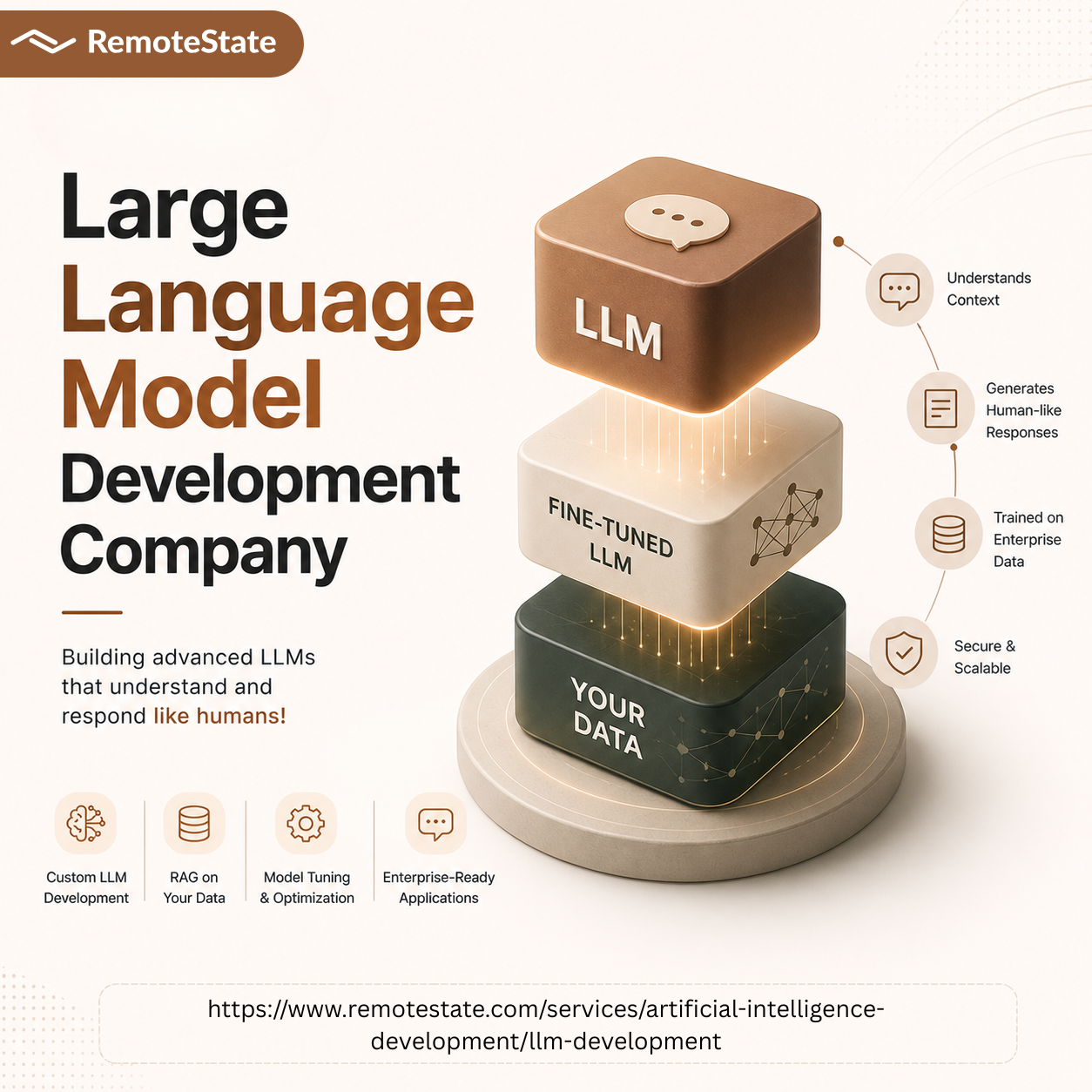
• Leading LLM Development Company for Custom AI Language Solutions
    LLM development company delivering advanced large language models tailored to your business. Build, fine-tune, and deploy secure, scalable AI solutions using enterprise data, RAG pipelines, and model optimization to generate human-like responses and drive intelligent automation. Visit us: https://www.remotestate.com/services/artificial-intelligence-development/llm-development
    Leading LLM Development Company for Custom AI Language Solutions LLM development company delivering advanced large language models tailored to your business. Build, fine-tune, and deploy secure, scalable AI solutions using enterprise data, RAG pipelines, and model optimization to generate human-like responses and drive intelligent automation. Visit us: https://www.remotestate.com/services/artificial-intelligence-development/llm-development
    0 Comments 0 Shares 2K Views 0 Reviews
  • Intelisync is a modern technology company focused on building advanced digital solutions using blockchain, Web3, and artificial intelligence (AI). Founded in 2023, it operates globally with a strong presence in locations like Dubai and India, helping startups and enterprises grow in the digital economy.

    Intelisync specializes in developing secure, scalable decentralized applications (dApps) and blockchain ecosystems. Its core expertise includes DeFi (Decentralized Finance), Real-World Asset (RWA) tokenization, smart contracts, crypto exchanges (DEX/CEX), and Layer 2 scaling solutions. The company also integrates AI technologies, cybersecurity, and cloud infrastructure to deliver complete, future-ready systems.
    Beyond development, Intelisync is also known for its Web3 marketing and growth strategies, offering services like influencer marketing, community building, branding, and PR campaigns to help projects gain traction and user adoption.

    The company’s mission is to simplify complex technologies and enable businesses to scale securely, while its vision focuses on leading innovation in the Web3 and blockchain space. By combining technical development with strategic marketing, Intelisync helps businesses transform ideas into real-world digital products and thrive in a decentralized, AI-driven future.
    In short: Intelisync is a full-service blockchain + AI + Web3 development and marketing company that empowers businesses to build, launch, and scale next-generation digital solutions.

    Visit our site for more information and discover how Intelisync can transform your business with cutting-edge digital solutions: https://intelisync.io/
    Intelisync is a modern technology company focused on building advanced digital solutions using blockchain, Web3, and artificial intelligence (AI). Founded in 2023, it operates globally with a strong presence in locations like Dubai and India, helping startups and enterprises grow in the digital economy. Intelisync specializes in developing secure, scalable decentralized applications (dApps) and blockchain ecosystems. Its core expertise includes DeFi (Decentralized Finance), Real-World Asset (RWA) tokenization, smart contracts, crypto exchanges (DEX/CEX), and Layer 2 scaling solutions. The company also integrates AI technologies, cybersecurity, and cloud infrastructure to deliver complete, future-ready systems. Beyond development, Intelisync is also known for its Web3 marketing and growth strategies, offering services like influencer marketing, community building, branding, and PR campaigns to help projects gain traction and user adoption. The company’s mission is to simplify complex technologies and enable businesses to scale securely, while its vision focuses on leading innovation in the Web3 and blockchain space. By combining technical development with strategic marketing, Intelisync helps businesses transform ideas into real-world digital products and thrive in a decentralized, AI-driven future. In short: Intelisync is a full-service blockchain + AI + Web3 development and marketing company that empowers businesses to build, launch, and scale next-generation digital solutions. Visit our site for more information and discover how Intelisync can transform your business with cutting-edge digital solutions: https://intelisync.io/
    Web3 Marketing Agency & Blockchain AI Growth Experts | Intelisync
    Performance-driven Web3 marketing, token launch strategy, AI-powered growth systems, and blockchain consulting for startups and enterprises. Book your demo.
    0 Comments 0 Shares 11K Views 0 Reviews
  • The rapid evolution of Large Language Models (LLMs) has introduced a fascinating new frontier in software development: prompt engineering. No longer is it sufficient to simply write code; developers and users alike must now master the art of crafting precise, effective prompts to elicit desired outputs from these powerful AI systems. This burgeoning discipline is crucial for unlocking the full potential of LLMs across a vast array of applications, from content generation and automated coding to complex data analysis and personalized user experiences.

    At its core, prompt engineering involves understanding how LLMs interpret language and a systematic approach to designing inputs that guide the model toward accurate, relevant, and creative responses. It's an iterative process that often requires experimentation, fine-tuning parameters, and a deep appreciation for the nuances of natural language. For instance, a developer building a chatbot might experiment with different phrasings, include specific examples, or define clear constraints within a prompt to ensure the bot provides helpful and coherent answers rather than generic or nonsensical ones.

    The implications of effective prompt engineering extend beyond mere output optimization. It's becoming a vital skill for ensuring AI safety and mitigating risks. By carefully constructing prompts, engineers can attempt to steer LLMs away from generating harmful content, biased information, or revealing sensitive data. This proactive approach is essential as LLMs become more integrated into our daily lives and professional workflows, demanding a robust understanding of how to control their behavior.

    Furthermore, prompt engineering is democratizing AI access. As LLMs become more accessible, individuals without deep coding expertise can leverage their power through well-designed prompts. This opens up new avenues for innovation and problem-solving, empowering a wider range of users to interact with and benefit from advanced AI capabilities. The ability to articulate a need or a query clearly in natural language is rapidly becoming as important as traditional programming skills for certain tasks.

    As the field matures, we can expect the development of more sophisticated prompt engineering tools and methodologies, potentially including automated prompt generation and validation. The ongoing research into LLM architectures and their emergent behaviors will undoubtedly inform and refine these practices. For software engineers and AI enthusiasts alike, mastering prompt engineering is no longer an optional extra but a fundamental competency for navigating the exciting and transformative landscape of artificial intelligence.
    The rapid evolution of Large Language Models (LLMs) has introduced a fascinating new frontier in software development: prompt engineering. No longer is it sufficient to simply write code; developers and users alike must now master the art of crafting precise, effective prompts to elicit desired outputs from these powerful AI systems. This burgeoning discipline is crucial for unlocking the full potential of LLMs across a vast array of applications, from content generation and automated coding to complex data analysis and personalized user experiences. At its core, prompt engineering involves understanding how LLMs interpret language and a systematic approach to designing inputs that guide the model toward accurate, relevant, and creative responses. It's an iterative process that often requires experimentation, fine-tuning parameters, and a deep appreciation for the nuances of natural language. For instance, a developer building a chatbot might experiment with different phrasings, include specific examples, or define clear constraints within a prompt to ensure the bot provides helpful and coherent answers rather than generic or nonsensical ones. The implications of effective prompt engineering extend beyond mere output optimization. It's becoming a vital skill for ensuring AI safety and mitigating risks. By carefully constructing prompts, engineers can attempt to steer LLMs away from generating harmful content, biased information, or revealing sensitive data. This proactive approach is essential as LLMs become more integrated into our daily lives and professional workflows, demanding a robust understanding of how to control their behavior. Furthermore, prompt engineering is democratizing AI access. As LLMs become more accessible, individuals without deep coding expertise can leverage their power through well-designed prompts. This opens up new avenues for innovation and problem-solving, empowering a wider range of users to interact with and benefit from advanced AI capabilities. The ability to articulate a need or a query clearly in natural language is rapidly becoming as important as traditional programming skills for certain tasks. As the field matures, we can expect the development of more sophisticated prompt engineering tools and methodologies, potentially including automated prompt generation and validation. The ongoing research into LLM architectures and their emergent behaviors will undoubtedly inform and refine these practices. For software engineers and AI enthusiasts alike, mastering prompt engineering is no longer an optional extra but a fundamental competency for navigating the exciting and transformative landscape of artificial intelligence.
    0 Comments 0 Shares 19K Views 0 Reviews
  • The integration of Large Language Models (LLMs) into the software development lifecycle is no longer a distant futuristic concept; it's a rapidly evolving reality. From generating boilerplate code to assisting in debugging and documentation, LLMs are proving to be powerful copilots for developers. However, this newfound efficiency comes with a critical caveat: security. The very nature of LLMs, trained on vast datasets of existing code, means they can inadvertently introduce vulnerabilities, replicate insecure coding patterns, or even become vectors for new attack types.

    One of the primary concerns is the potential for LLMs to generate code with inherent security flaws. If the training data contains examples of common vulnerabilities, such as SQL injection, cross-site scripting (XSS), or insecure deserialization, the LLM might learn and reproduce these weaknesses in the code it generates. This necessitates a robust oversight mechanism, moving beyond simply accepting generated code at face value. Developers must still exercise their critical judgment, performing rigorous code reviews and employing automated security scanning tools to catch these subtle, yet potentially devastating, errors.

    Furthermore, the reliance on LLMs for code completion and generation can also lead to a dilution of developer expertise in security. Junior developers, in particular, might become overly dependent on these tools, potentially hindering their understanding of fundamental security principles. As LLMs become more sophisticated, they could also be leveraged by malicious actors to craft more sophisticated and targeted attacks. Imagine LLMs being used to automatically identify and exploit common vulnerabilities across a wide range of applications, or to generate highly convincing phishing emails at scale.

    Addressing these challenges requires a multi-pronged approach. Firstly, the development of LLMs themselves needs to incorporate security considerations from the outset. This includes curating more secure training datasets, developing methods to identify and filter out insecure code patterns, and building in mechanisms for vulnerability detection during the generation process. Secondly, the software development tools and workflows need to adapt. IDEs could feature integrated LLM security checks, providing real-time feedback on potentially insecure code suggestions.

    Ultimately, the successful integration of LLMs into software engineering hinges on a partnership between human intelligence and artificial intelligence. LLMs are powerful accelerators, but they are not replacements for human diligence, critical thinking, and a deep understanding of security best practices. By acknowledging the security implications and proactively developing robust safeguards, we can harness the transformative potential of LLMs while ensuring the integrity and security of the software we build. The future of secure software development will likely involve intelligent tools assisting human developers, but the human element will remain the ultimate guardian of security.
    The integration of Large Language Models (LLMs) into the software development lifecycle is no longer a distant futuristic concept; it's a rapidly evolving reality. From generating boilerplate code to assisting in debugging and documentation, LLMs are proving to be powerful copilots for developers. However, this newfound efficiency comes with a critical caveat: security. The very nature of LLMs, trained on vast datasets of existing code, means they can inadvertently introduce vulnerabilities, replicate insecure coding patterns, or even become vectors for new attack types. One of the primary concerns is the potential for LLMs to generate code with inherent security flaws. If the training data contains examples of common vulnerabilities, such as SQL injection, cross-site scripting (XSS), or insecure deserialization, the LLM might learn and reproduce these weaknesses in the code it generates. This necessitates a robust oversight mechanism, moving beyond simply accepting generated code at face value. Developers must still exercise their critical judgment, performing rigorous code reviews and employing automated security scanning tools to catch these subtle, yet potentially devastating, errors. Furthermore, the reliance on LLMs for code completion and generation can also lead to a dilution of developer expertise in security. Junior developers, in particular, might become overly dependent on these tools, potentially hindering their understanding of fundamental security principles. As LLMs become more sophisticated, they could also be leveraged by malicious actors to craft more sophisticated and targeted attacks. Imagine LLMs being used to automatically identify and exploit common vulnerabilities across a wide range of applications, or to generate highly convincing phishing emails at scale. Addressing these challenges requires a multi-pronged approach. Firstly, the development of LLMs themselves needs to incorporate security considerations from the outset. This includes curating more secure training datasets, developing methods to identify and filter out insecure code patterns, and building in mechanisms for vulnerability detection during the generation process. Secondly, the software development tools and workflows need to adapt. IDEs could feature integrated LLM security checks, providing real-time feedback on potentially insecure code suggestions. Ultimately, the successful integration of LLMs into software engineering hinges on a partnership between human intelligence and artificial intelligence. LLMs are powerful accelerators, but they are not replacements for human diligence, critical thinking, and a deep understanding of security best practices. By acknowledging the security implications and proactively developing robust safeguards, we can harness the transformative potential of LLMs while ensuring the integrity and security of the software we build. The future of secure software development will likely involve intelligent tools assisting human developers, but the human element will remain the ultimate guardian of security.
    0 Comments 0 Shares 11K Views 0 Reviews
  • The proliferation of Large Language Models (LLMs) like GPT-3 and its successors has undeniably reshaped the landscape of artificial intelligence, ushering in an era of sophisticated natural language understanding and generation. These models, trained on vast swathes of text and code, exhibit remarkable capabilities in tasks ranging from creative writing and complex code generation to nuanced question answering and personalized content creation. Their ability to grasp context, infer meaning, and produce human-like text has opened up novel avenues for innovation across numerous industries.

    However, with great power comes great responsibility, and the rapid advancement of LLMs also presents significant cybersecurity challenges. One of the most pressing concerns is the potential for LLMs to be exploited for malicious purposes. Generative AI can be weaponized to craft highly convincing phishing emails, generate realistic fake news articles, or even create sophisticated social engineering campaigns at scale. The sheer volume and personalized nature of such attacks, powered by LLMs, could overwhelm existing defenses and make it increasingly difficult for individuals and organizations to discern truth from fiction.

    Beyond direct malicious use, the inherent complexities of LLMs also introduce new vulnerabilities. Prompt injection attacks, where malicious instructions are subtly embedded within user prompts, can trick LLMs into performing unintended actions, potentially revealing sensitive information or executing unauthorized commands. Furthermore, the data used to train these models can inadvertently contain or become a source of sensitive information, leading to potential data leakage if not properly managed and secured. Ensuring the security and privacy of the data feeding these powerful models, as well as the integrity of their internal operations, is a paramount concern for developers and users alike.

    Addressing these burgeoning cybersecurity risks requires a multi-pronged approach. For developers, this involves building robust guardrails and ethical considerations directly into LLM architectures, implementing sophisticated input validation and output sanitization techniques to detect and mitigate malicious prompts, and continuously monitoring model behavior for anomalies. For end-users and organizations, the focus needs to shift towards enhanced digital literacy, critical thinking, and the adoption of advanced detection tools that can identify AI-generated disinformation or malicious content. Security awareness training must evolve to educate individuals about the evolving threat landscape posed by LLMs.

    The future of LLMs is bright, promising further breakthroughs in human-computer interaction and problem-solving. Yet, as we embrace these transformative technologies, a proactive and vigilant stance on cybersecurity is not merely advisable, but essential. By fostering collaboration between AI researchers, cybersecurity experts, and policymakers, we can strive to harness the immense potential of LLMs while effectively navigating and mitigating the inherent risks, ensuring a safer and more trustworthy digital future.
    The proliferation of Large Language Models (LLMs) like GPT-3 and its successors has undeniably reshaped the landscape of artificial intelligence, ushering in an era of sophisticated natural language understanding and generation. These models, trained on vast swathes of text and code, exhibit remarkable capabilities in tasks ranging from creative writing and complex code generation to nuanced question answering and personalized content creation. Their ability to grasp context, infer meaning, and produce human-like text has opened up novel avenues for innovation across numerous industries. However, with great power comes great responsibility, and the rapid advancement of LLMs also presents significant cybersecurity challenges. One of the most pressing concerns is the potential for LLMs to be exploited for malicious purposes. Generative AI can be weaponized to craft highly convincing phishing emails, generate realistic fake news articles, or even create sophisticated social engineering campaigns at scale. The sheer volume and personalized nature of such attacks, powered by LLMs, could overwhelm existing defenses and make it increasingly difficult for individuals and organizations to discern truth from fiction. Beyond direct malicious use, the inherent complexities of LLMs also introduce new vulnerabilities. Prompt injection attacks, where malicious instructions are subtly embedded within user prompts, can trick LLMs into performing unintended actions, potentially revealing sensitive information or executing unauthorized commands. Furthermore, the data used to train these models can inadvertently contain or become a source of sensitive information, leading to potential data leakage if not properly managed and secured. Ensuring the security and privacy of the data feeding these powerful models, as well as the integrity of their internal operations, is a paramount concern for developers and users alike. Addressing these burgeoning cybersecurity risks requires a multi-pronged approach. For developers, this involves building robust guardrails and ethical considerations directly into LLM architectures, implementing sophisticated input validation and output sanitization techniques to detect and mitigate malicious prompts, and continuously monitoring model behavior for anomalies. For end-users and organizations, the focus needs to shift towards enhanced digital literacy, critical thinking, and the adoption of advanced detection tools that can identify AI-generated disinformation or malicious content. Security awareness training must evolve to educate individuals about the evolving threat landscape posed by LLMs. The future of LLMs is bright, promising further breakthroughs in human-computer interaction and problem-solving. Yet, as we embrace these transformative technologies, a proactive and vigilant stance on cybersecurity is not merely advisable, but essential. By fostering collaboration between AI researchers, cybersecurity experts, and policymakers, we can strive to harness the immense potential of LLMs while effectively navigating and mitigating the inherent risks, ensuring a safer and more trustworthy digital future.
    0 Comments 0 Shares 11K Views 0 Reviews
  • The rise of Large Language Models (LLMs) like GPT-3, BERT, and their successors has undeniably revolutionized the landscape of Natural Language Processing (NLP). These models, characterized by their massive scale and the sophisticated transformer architecture, have demonstrated an uncanny ability to understand, generate, and even reason with human language across a wide spectrum of tasks. From drafting emails and writing code to summarizing complex documents and engaging in nuanced conversations, LLMs are rapidly becoming indispensable tools for both developers and end-users, driving innovation and pushing the boundaries of what was previously thought possible in artificial intelligence.

    However, this remarkable advancement comes with a significant set of challenges, particularly in the realm of security and privacy. The very power of LLMs, their capacity to process and generate human-like text, also makes them potent tools for malicious actors. Prompt injection attacks, where adversarial inputs are crafted to manipulate an LLM into performing unintended actions or revealing sensitive information, are a prime example. These attacks highlight a fundamental vulnerability in how LLMs interpret and execute instructions, often based on the input provided, without robust underlying security checks. The implications are far-reaching, potentially leading to data breaches, the dissemination of misinformation, or the execution of unauthorized commands.

    Furthermore, the opaque nature of these large-scale models presents a significant hurdle for auditing and ensuring ethical deployment. Understanding the decision-making process of an LLM, especially when it errs or produces biased output, is exceedingly difficult due to their complex internal structures. This lack of interpretability makes it challenging to identify and rectify biases inherited from their training data, or to ensure that the model is not generating harmful or discriminatory content. Building trust in LLMs necessitates advancements in explainable AI (XAI) techniques tailored for these massive models, allowing us to probe their internal workings and understand the rationale behind their outputs.

    Addressing these security and ethical concerns is paramount for the responsible development and widespread adoption of LLMs. This involves a multi-pronged approach. Firstly, robust input validation and sanitization mechanisms are crucial to mitigate prompt injection risks, treating LLM inputs with the same adversarial scrutiny as any other form of user-generated content. Secondly, ongoing research into adversarial training and model robustness is essential, aiming to make LLMs more resilient to manipulation. Thirdly, significant investment in XAI research is needed to develop methods for interpreting LLM behavior, enabling better debugging, bias detection, and ethical oversight. Finally, establishing clear guidelines and best practices for LLM development and deployment, fostering collaboration between researchers, developers, and policymakers, will be key to navigating this rapidly evolving frontier responsibly. The future of LLMs is bright, but ensuring their security and ethical alignment is a shared responsibility that demands our immediate attention.

    The rise of Large Language Models (LLMs) like GPT-3, BERT, and their successors has undeniably revolutionized the landscape of Natural Language Processing (NLP). These models, characterized by their massive scale and the sophisticated transformer architecture, have demonstrated an uncanny ability to understand, generate, and even reason with human language across a wide spectrum of tasks. From drafting emails and writing code to summarizing complex documents and engaging in nuanced conversations, LLMs are rapidly becoming indispensable tools for both developers and end-users, driving innovation and pushing the boundaries of what was previously thought possible in artificial intelligence. However, this remarkable advancement comes with a significant set of challenges, particularly in the realm of security and privacy. The very power of LLMs, their capacity to process and generate human-like text, also makes them potent tools for malicious actors. Prompt injection attacks, where adversarial inputs are crafted to manipulate an LLM into performing unintended actions or revealing sensitive information, are a prime example. These attacks highlight a fundamental vulnerability in how LLMs interpret and execute instructions, often based on the input provided, without robust underlying security checks. The implications are far-reaching, potentially leading to data breaches, the dissemination of misinformation, or the execution of unauthorized commands. Furthermore, the opaque nature of these large-scale models presents a significant hurdle for auditing and ensuring ethical deployment. Understanding the decision-making process of an LLM, especially when it errs or produces biased output, is exceedingly difficult due to their complex internal structures. This lack of interpretability makes it challenging to identify and rectify biases inherited from their training data, or to ensure that the model is not generating harmful or discriminatory content. Building trust in LLMs necessitates advancements in explainable AI (XAI) techniques tailored for these massive models, allowing us to probe their internal workings and understand the rationale behind their outputs. Addressing these security and ethical concerns is paramount for the responsible development and widespread adoption of LLMs. This involves a multi-pronged approach. Firstly, robust input validation and sanitization mechanisms are crucial to mitigate prompt injection risks, treating LLM inputs with the same adversarial scrutiny as any other form of user-generated content. Secondly, ongoing research into adversarial training and model robustness is essential, aiming to make LLMs more resilient to manipulation. Thirdly, significant investment in XAI research is needed to develop methods for interpreting LLM behavior, enabling better debugging, bias detection, and ethical oversight. Finally, establishing clear guidelines and best practices for LLM development and deployment, fostering collaboration between researchers, developers, and policymakers, will be key to navigating this rapidly evolving frontier responsibly. The future of LLMs is bright, but ensuring their security and ethical alignment is a shared responsibility that demands our immediate attention.
    0 Comments 0 Shares 7K Views 0 Reviews
  • The rise of Large Language Models (LLMs) has undeniably reshaped the technological landscape, ushering in an era where natural language understanding and generation are more accessible and powerful than ever. From assisting with creative writing to powering sophisticated chatbots and summarization tools, LLMs like GPT-3, LaMDA, and their successors are demonstrating remarkable capabilities. However, this rapid advancement also brings a crucial set of challenges, particularly concerning bias and fairness. LLMs are trained on vast datasets scraped from the internet, and unfortunately, the internet itself is a reflection of human society, complete with its inherent biases and prejudices. When these biases are encoded into the training data, they are inevitably learned and perpetuated by the LLMs, leading to outputs that can be discriminatory, unfair, or even harmful.

    Addressing bias in LLMs is not merely an ethical imperative; it is a technical necessity for their widespread and responsible adoption. The consequences of biased AI systems are far-reaching, impacting areas like hiring, loan applications, content moderation, and even legal judgments. For instance, an LLM trained on historical hiring data that favors a particular demographic might unfairly disadvantage equally qualified candidates from underrepresented groups. Similarly, biased models can generate offensive or stereotypical content, further marginalizing already vulnerable communities. Researchers and developers are actively exploring various techniques to mitigate these issues, ranging from careful data curation and filtering to sophisticated model fine-tuning and bias detection algorithms.

    One promising approach involves scrutinizing and augmenting training datasets. This includes identifying and removing biased language, diversifying the data sources to represent a broader spectrum of perspectives, and even generating synthetic data to balance underrepresented viewpoints. Another critical area of research focuses on developing methods to audit and measure bias within LLMs themselves. This involves creating benchmarks and evaluation frameworks that can systematically assess a model's behavior across different demographic groups and scenarios. Techniques like counterfactual data augmentation, where inputs are systematically altered to test for differential responses, are proving valuable in uncovering subtle biases.

    Furthermore, the development of "explainable AI" (XAI) plays a vital role. By understanding how LLMs arrive at their decisions, we can better identify the root causes of biased outputs and implement targeted interventions. Techniques that highlight the most influential parts of the input data or the internal model workings can provide insights into why a particular output was generated, aiding in the debugging and refinement process. Ultimately, building fair and unbiased LLMs requires a multi-faceted approach. It demands collaboration between AI researchers, ethicists, social scientists, and policymakers. Continuous monitoring, rigorous evaluation, and a commitment to transparency will be essential as we navigate the evolving landscape of artificial intelligence and strive to create technologies that benefit all of humanity equitably.
    The rise of Large Language Models (LLMs) has undeniably reshaped the technological landscape, ushering in an era where natural language understanding and generation are more accessible and powerful than ever. From assisting with creative writing to powering sophisticated chatbots and summarization tools, LLMs like GPT-3, LaMDA, and their successors are demonstrating remarkable capabilities. However, this rapid advancement also brings a crucial set of challenges, particularly concerning bias and fairness. LLMs are trained on vast datasets scraped from the internet, and unfortunately, the internet itself is a reflection of human society, complete with its inherent biases and prejudices. When these biases are encoded into the training data, they are inevitably learned and perpetuated by the LLMs, leading to outputs that can be discriminatory, unfair, or even harmful. Addressing bias in LLMs is not merely an ethical imperative; it is a technical necessity for their widespread and responsible adoption. The consequences of biased AI systems are far-reaching, impacting areas like hiring, loan applications, content moderation, and even legal judgments. For instance, an LLM trained on historical hiring data that favors a particular demographic might unfairly disadvantage equally qualified candidates from underrepresented groups. Similarly, biased models can generate offensive or stereotypical content, further marginalizing already vulnerable communities. Researchers and developers are actively exploring various techniques to mitigate these issues, ranging from careful data curation and filtering to sophisticated model fine-tuning and bias detection algorithms. One promising approach involves scrutinizing and augmenting training datasets. This includes identifying and removing biased language, diversifying the data sources to represent a broader spectrum of perspectives, and even generating synthetic data to balance underrepresented viewpoints. Another critical area of research focuses on developing methods to audit and measure bias within LLMs themselves. This involves creating benchmarks and evaluation frameworks that can systematically assess a model's behavior across different demographic groups and scenarios. Techniques like counterfactual data augmentation, where inputs are systematically altered to test for differential responses, are proving valuable in uncovering subtle biases. Furthermore, the development of "explainable AI" (XAI) plays a vital role. By understanding how LLMs arrive at their decisions, we can better identify the root causes of biased outputs and implement targeted interventions. Techniques that highlight the most influential parts of the input data or the internal model workings can provide insights into why a particular output was generated, aiding in the debugging and refinement process. Ultimately, building fair and unbiased LLMs requires a multi-faceted approach. It demands collaboration between AI researchers, ethicists, social scientists, and policymakers. Continuous monitoring, rigorous evaluation, and a commitment to transparency will be essential as we navigate the evolving landscape of artificial intelligence and strive to create technologies that benefit all of humanity equitably.
    0 Comments 0 Shares 6K Views 0 Reviews
  • The generative AI surge, particularly with Large Language Models (LLMs), has undeniably reshaped the software engineering landscape. Beyond the initial excitement of code completion and text generation, a deeper transformation is underway, focusing on how we architect, develop, and deploy applications. This isn't just about faster coding; it's about fundamentally rethinking software lifecycles and embracing AI as a core engineering partner.

    One of the most impactful shifts is the rise of "AI-assisted development." Tools that were once novelties are now integral to many developer workflows. Think of AI suggesting test cases, identifying potential bugs before they are even written, or even auto-generating boilerplate code based on natural language descriptions. This frees up engineers to focus on more complex problem-solving, architectural design, and the nuances that still require human ingenuity. The emphasis is shifting from rote coding to intelligent problem decomposition and validation.

    Furthermore, the integration of LLMs into product development itself is accelerating. Applications are no longer just about structured data; they can now understand and respond to unstructured user input with unprecedented fluency. This opens doors for more intuitive user interfaces, sophisticated chatbots that can handle complex queries, and personalized content generation at scale. However, this also introduces new challenges in terms of managing context, ensuring factual accuracy, and mitigating biases inherent in the training data.

    The operational side of software engineering is also being revolutionized. AI is proving invaluable in areas like AIOps (Artificial Intelligence for IT Operations), where it can predict infrastructure failures, automate incident response, and optimize resource allocation. This proactive approach to system management promises greater reliability and efficiency, reducing downtime and manual intervention. As systems become more complex, AI's ability to sift through vast amounts of telemetry data and identify root causes becomes indispensable.

    Looking ahead, the fusion of AI and software engineering will likely lead to even more profound changes. We can anticipate the development of self-healing systems, applications that can dynamically adapt their behavior based on real-time user needs, and entirely new paradigms of human-computer interaction. While the ethical considerations and security implications of pervasive AI integration will remain critical, the trajectory is clear: AI is not just a tool for engineers; it is becoming a foundational element of modern software itself.
    The generative AI surge, particularly with Large Language Models (LLMs), has undeniably reshaped the software engineering landscape. Beyond the initial excitement of code completion and text generation, a deeper transformation is underway, focusing on how we architect, develop, and deploy applications. This isn't just about faster coding; it's about fundamentally rethinking software lifecycles and embracing AI as a core engineering partner. One of the most impactful shifts is the rise of "AI-assisted development." Tools that were once novelties are now integral to many developer workflows. Think of AI suggesting test cases, identifying potential bugs before they are even written, or even auto-generating boilerplate code based on natural language descriptions. This frees up engineers to focus on more complex problem-solving, architectural design, and the nuances that still require human ingenuity. The emphasis is shifting from rote coding to intelligent problem decomposition and validation. Furthermore, the integration of LLMs into product development itself is accelerating. Applications are no longer just about structured data; they can now understand and respond to unstructured user input with unprecedented fluency. This opens doors for more intuitive user interfaces, sophisticated chatbots that can handle complex queries, and personalized content generation at scale. However, this also introduces new challenges in terms of managing context, ensuring factual accuracy, and mitigating biases inherent in the training data. The operational side of software engineering is also being revolutionized. AI is proving invaluable in areas like AIOps (Artificial Intelligence for IT Operations), where it can predict infrastructure failures, automate incident response, and optimize resource allocation. This proactive approach to system management promises greater reliability and efficiency, reducing downtime and manual intervention. As systems become more complex, AI's ability to sift through vast amounts of telemetry data and identify root causes becomes indispensable. Looking ahead, the fusion of AI and software engineering will likely lead to even more profound changes. We can anticipate the development of self-healing systems, applications that can dynamically adapt their behavior based on real-time user needs, and entirely new paradigms of human-computer interaction. While the ethical considerations and security implications of pervasive AI integration will remain critical, the trajectory is clear: AI is not just a tool for engineers; it is becoming a foundational element of modern software itself.
    0 Comments 0 Shares 7K Views 0 Reviews
  • The rapid evolution of Large Language Models (LLMs) like GPT-4, LaMDA, and others has ignited a significant shift in how we interact with and leverage artificial intelligence. Beyond their impressive capabilities in content generation and summarization, LLMs are increasingly being integrated into the very fabric of software development. This trend is not merely about automating boilerplate code; it's about fundamentally changing the developer experience, accelerating innovation, and opening up new possibilities for application design and functionality.

    One of the most immediate impacts is on code generation and assistance. LLMs can now draft code snippets, suggest completions, identify potential bugs, and even translate code between different programming languages with remarkable accuracy. This reduces the time developers spend on repetitive tasks, allowing them to focus on higher-level architectural decisions and problem-solving. Tools built upon these models are transforming IDEs into intelligent co-pilots, offering context-aware suggestions that go far beyond traditional autocompletion.

    Furthermore, LLMs are facilitating a more natural language approach to software interaction and development. This means that even non-technical users can potentially contribute to or direct software development through descriptive prompts, lowering the barrier to entry for certain tasks. Think of it as a more sophisticated form of low-code/no-code, where the "code" is expressed in human language, and the LLM translates it into executable instructions. This democratization of software creation has the potential to unlock new levels of creativity and customization.

    The implications extend to testing and debugging as well. LLMs can be trained to generate comprehensive test cases, identify edge cases that human developers might overlook, and even provide detailed explanations for errors. This can lead to more robust and reliable software, as well as faster iteration cycles during the development process. The ability of LLMs to understand complex logic and potential failure points is a powerful asset in ensuring software quality.

    However, this transformative integration of LLMs into software engineering is not without its challenges. Ensuring the security and privacy of code and data processed by these models is paramount. Developers must be mindful of prompt injection vulnerabilities, data leakage, and the potential for LLMs to generate insecure or biased code. Rigorous validation, ethical guidelines, and robust security measures are essential as we embrace this new era of AI-assisted development. The journey is just beginning, and understanding these nuances will be critical for harnessing the full potential of LLMs in shaping the future of software.
    The rapid evolution of Large Language Models (LLMs) like GPT-4, LaMDA, and others has ignited a significant shift in how we interact with and leverage artificial intelligence. Beyond their impressive capabilities in content generation and summarization, LLMs are increasingly being integrated into the very fabric of software development. This trend is not merely about automating boilerplate code; it's about fundamentally changing the developer experience, accelerating innovation, and opening up new possibilities for application design and functionality. One of the most immediate impacts is on code generation and assistance. LLMs can now draft code snippets, suggest completions, identify potential bugs, and even translate code between different programming languages with remarkable accuracy. This reduces the time developers spend on repetitive tasks, allowing them to focus on higher-level architectural decisions and problem-solving. Tools built upon these models are transforming IDEs into intelligent co-pilots, offering context-aware suggestions that go far beyond traditional autocompletion. Furthermore, LLMs are facilitating a more natural language approach to software interaction and development. This means that even non-technical users can potentially contribute to or direct software development through descriptive prompts, lowering the barrier to entry for certain tasks. Think of it as a more sophisticated form of low-code/no-code, where the "code" is expressed in human language, and the LLM translates it into executable instructions. This democratization of software creation has the potential to unlock new levels of creativity and customization. The implications extend to testing and debugging as well. LLMs can be trained to generate comprehensive test cases, identify edge cases that human developers might overlook, and even provide detailed explanations for errors. This can lead to more robust and reliable software, as well as faster iteration cycles during the development process. The ability of LLMs to understand complex logic and potential failure points is a powerful asset in ensuring software quality. However, this transformative integration of LLMs into software engineering is not without its challenges. Ensuring the security and privacy of code and data processed by these models is paramount. Developers must be mindful of prompt injection vulnerabilities, data leakage, and the potential for LLMs to generate insecure or biased code. Rigorous validation, ethical guidelines, and robust security measures are essential as we embrace this new era of AI-assisted development. The journey is just beginning, and understanding these nuances will be critical for harnessing the full potential of LLMs in shaping the future of software.
    0 Comments 0 Shares 6K Views 0 Reviews
  • The rapid evolution of Artificial Intelligence (AI) has placed a spotlight on the critical need for robust AI security. As AI systems become more integrated into our daily lives and critical infrastructure, understanding and mitigating the unique vulnerabilities they present is paramount. Unlike traditional software, AI models, particularly deep learning networks, introduce novel attack vectors that require a specialized approach to defense.

    One of the most discussed threats is adversarial machine learning. This involves subtly manipulating input data in a way that is imperceptible to humans but causes the AI model to make incorrect predictions. For instance, a few strategically altered pixels in an image could lead an autonomous vehicle's object detection system to misclassify a stop sign as a speed limit sign, with potentially disastrous consequences. These attacks can be designed to cause misclassification, denial of service, or even to extract sensitive information about the model itself.

    Another significant concern is data poisoning. Attackers can intentionally inject malicious data into the training dataset of an AI model. This can corrupt the model's learning process, leading it to develop biases, backdoor vulnerabilities, or simply perform poorly. If an AI system is trained on compromised data, its subsequent decisions will be inherently flawed and untrustworthy, impacting everything from financial predictions to medical diagnoses.

    Furthermore, the complexity of deep learning models often makes them a "black box," hindering our ability to fully understand their decision-making processes. This lack of interpretability, known as the explainability problem, makes it challenging to detect subtle anomalies or to ascertain why a particular output was generated. Without transparency, identifying and rectifying security breaches within these intricate models becomes a formidable task.

    Addressing these challenges requires a multi-layered security strategy tailored for AI. This includes developing robust data validation and sanitization techniques to prevent poisoning, implementing adversarial training methods to make models more resilient to manipulation, and investing in research to improve model interpretability and explainability. As AI continues its inexorable march forward, prioritizing and innovating in AI security is not merely an option, but an absolute necessity to ensure its safe and beneficial deployment.
    The rapid evolution of Artificial Intelligence (AI) has placed a spotlight on the critical need for robust AI security. As AI systems become more integrated into our daily lives and critical infrastructure, understanding and mitigating the unique vulnerabilities they present is paramount. Unlike traditional software, AI models, particularly deep learning networks, introduce novel attack vectors that require a specialized approach to defense. One of the most discussed threats is adversarial machine learning. This involves subtly manipulating input data in a way that is imperceptible to humans but causes the AI model to make incorrect predictions. For instance, a few strategically altered pixels in an image could lead an autonomous vehicle's object detection system to misclassify a stop sign as a speed limit sign, with potentially disastrous consequences. These attacks can be designed to cause misclassification, denial of service, or even to extract sensitive information about the model itself. Another significant concern is data poisoning. Attackers can intentionally inject malicious data into the training dataset of an AI model. This can corrupt the model's learning process, leading it to develop biases, backdoor vulnerabilities, or simply perform poorly. If an AI system is trained on compromised data, its subsequent decisions will be inherently flawed and untrustworthy, impacting everything from financial predictions to medical diagnoses. Furthermore, the complexity of deep learning models often makes them a "black box," hindering our ability to fully understand their decision-making processes. This lack of interpretability, known as the explainability problem, makes it challenging to detect subtle anomalies or to ascertain why a particular output was generated. Without transparency, identifying and rectifying security breaches within these intricate models becomes a formidable task. Addressing these challenges requires a multi-layered security strategy tailored for AI. This includes developing robust data validation and sanitization techniques to prevent poisoning, implementing adversarial training methods to make models more resilient to manipulation, and investing in research to improve model interpretability and explainability. As AI continues its inexorable march forward, prioritizing and innovating in AI security is not merely an option, but an absolute necessity to ensure its safe and beneficial deployment.
    0 Comments 0 Shares 7K Views 0 Reviews
More Results
Ads