• Dell Refurbished Laptop for Everyday Work, Study, and Business | eazypc

    Looking for a reliable and budget-friendly laptop? A dell refurbished laptop is a practical choice for students, professionals, and home users who need smooth performance for daily tasks. At eazypc, we provide quality-tested refurbished Dell laptops designed for office work, online classes, browsing, and multitasking. Whether you are searching for a durable business laptop or a dependable device for personal use, our collection includes models that combine performance and value. A dell second hand laptop can help users access trusted Dell technology at a more affordable price while supporting sustainable technology use.

    visit - https://eazypc.in/product-category/dell-refurbished-laptops/
    Dell Refurbished Laptop for Everyday Work, Study, and Business | eazypc Looking for a reliable and budget-friendly laptop? A dell refurbished laptop is a practical choice for students, professionals, and home users who need smooth performance for daily tasks. At eazypc, we provide quality-tested refurbished Dell laptops designed for office work, online classes, browsing, and multitasking. Whether you are searching for a durable business laptop or a dependable device for personal use, our collection includes models that combine performance and value. A dell second hand laptop can help users access trusted Dell technology at a more affordable price while supporting sustainable technology use. visit - https://eazypc.in/product-category/dell-refurbished-laptops/
    EAZYPC.IN
    Buy Dell Refurbished Laptops India | Latitude & Precision | EazyPC
    Certified Dell Refurbished Laptops | Latitude & Precision laptops with 6-month warranty. i3, i5, i7 options starting ₹14,000. COD & EMI available. Shop EazyPC now.
    0 Comentários 0 Compartilhamentos 6KB Visualizações 0 Anterior
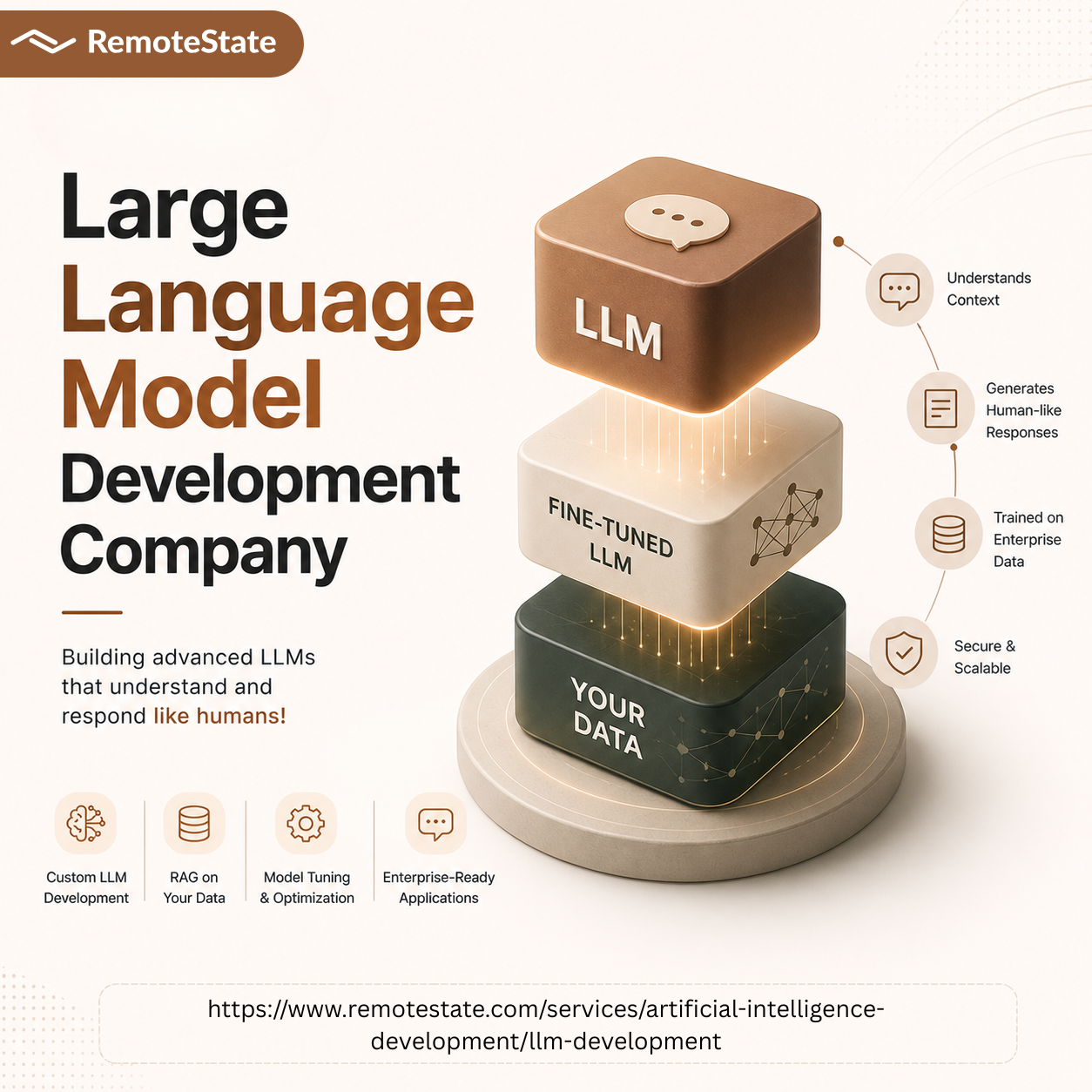
  • Leading LLM Development Company for Custom AI Language Solutions
    LLM development company delivering advanced large language models tailored to your business. Build, fine-tune, and deploy secure, scalable AI solutions using enterprise data, RAG pipelines, and model optimization to generate human-like responses and drive intelligent automation. Visit us: https://www.remotestate.com/services/artificial-intelligence-development/llm-development
    Leading LLM Development Company for Custom AI Language Solutions LLM development company delivering advanced large language models tailored to your business. Build, fine-tune, and deploy secure, scalable AI solutions using enterprise data, RAG pipelines, and model optimization to generate human-like responses and drive intelligent automation. Visit us: https://www.remotestate.com/services/artificial-intelligence-development/llm-development
    0 Comentários 0 Compartilhamentos 2KB Visualizações 0 Anterior
  • Hire Dedicated Software Development Team for Scalable Digital Solutions:
    Hire dedicated software development team experts to accelerate product development and scale efficiently. Access skilled developers, secure collaboration, and flexible engagement models to build high-performance solutions that align with your business goals and drive faster delivery. Visit us: https://www.remotestate.com/services/it-staff-augmentation/dedicated-development-team
    Hire Dedicated Software Development Team for Scalable Digital Solutions: Hire dedicated software development team experts to accelerate product development and scale efficiently. Access skilled developers, secure collaboration, and flexible engagement models to build high-performance solutions that align with your business goals and drive faster delivery. Visit us: https://www.remotestate.com/services/it-staff-augmentation/dedicated-development-team
    0 Comentários 0 Compartilhamentos 4KB Visualizações 0 Anterior
  • The buzz around generative AI has been incredible, and for good reason! It feels like just yesterday we were marveling at AI's ability to write basic sentences, and now we're seeing it whip up entire articles, stunning artwork, and even functional code. This leap from novelty to genuine utility is changing how we think about creativity and productivity, opening up new avenues for content creators, developers, and anyone looking to bring their ideas to life faster.

    What's particularly exciting is how accessible these tools are becoming. You don't need a Ph.D. in computer science to start playing with intelligent models. Whether it's crafting a catchy social media caption or generating a unique image for a personal project, generative AI is democratizing powerful creative capabilities, empowering more people to express themselves and build innovative things.

    As this technology continues to mature, we're only scratching the surface of its potential. The possibilities for collaboration between humans and AI are vast, promising to augment our abilities and push the boundaries of what we can achieve. It's a dynamic and fast-moving field, and it's definitely worth keeping an eye on as it reshapes various industries.
    The buzz around generative AI has been incredible, and for good reason! It feels like just yesterday we were marveling at AI's ability to write basic sentences, and now we're seeing it whip up entire articles, stunning artwork, and even functional code. This leap from novelty to genuine utility is changing how we think about creativity and productivity, opening up new avenues for content creators, developers, and anyone looking to bring their ideas to life faster. What's particularly exciting is how accessible these tools are becoming. You don't need a Ph.D. in computer science to start playing with intelligent models. Whether it's crafting a catchy social media caption or generating a unique image for a personal project, generative AI is democratizing powerful creative capabilities, empowering more people to express themselves and build innovative things. As this technology continues to mature, we're only scratching the surface of its potential. The possibilities for collaboration between humans and AI are vast, promising to augment our abilities and push the boundaries of what we can achieve. It's a dynamic and fast-moving field, and it's definitely worth keeping an eye on as it reshapes various industries.
    0 Comentários 0 Compartilhamentos 8KB Visualizações 0 Anterior
  • The rise of large language models (LLMs) is rapidly transforming the landscape of software development. These powerful AI systems are moving beyond mere text generation and are increasingly being leveraged for tasks that were once exclusive to human developers. Code completion is perhaps the most established application, with tools like GitHub Copilot already demonstrating significant productivity gains by suggesting lines or even entire functions of code based on context. This allows developers to focus on higher-level problem-solving and architectural design, rather than getting bogged down in repetitive coding tasks.

    Beyond simple completion, LLMs are showing promise in areas like code translation and refactoring. Imagine needing to port a legacy application from COBOL to Python, or to optimize a performance-critical section of Java code. LLMs can analyze existing code, understand its logic, and generate equivalent or improved code in a target language, significantly reducing the manual effort and potential for human error involved in these complex processes. This capability opens doors for modernizing older systems and improving the efficiency of existing codebases.

    Furthermore, LLMs are starting to impact the realm of testing and debugging. They can generate unit tests based on code descriptions or existing tests, ensuring better code coverage and identifying potential edge cases that might be overlooked. For debugging, LLMs can analyze error messages, stack traces, and code snippets to pinpoint the root cause of bugs and even suggest potential fixes. This proactive approach to quality assurance can dramatically shorten development cycles and improve software reliability.

    However, embracing LLMs in software engineering is not without its challenges. Ensuring the accuracy and security of generated code is paramount. LLMs can sometimes produce code with subtle bugs or security vulnerabilities, requiring diligent human review and robust testing practices. The ethical implications of AI-generated code, such as intellectual property concerns and potential job displacement, also warrant careful consideration as these technologies mature and become more integrated into development workflows. The future of software engineering likely involves a symbiotic relationship between human developers and AI assistants, where each leverages their unique strengths to build better software, faster and more efficiently.
    The rise of large language models (LLMs) is rapidly transforming the landscape of software development. These powerful AI systems are moving beyond mere text generation and are increasingly being leveraged for tasks that were once exclusive to human developers. Code completion is perhaps the most established application, with tools like GitHub Copilot already demonstrating significant productivity gains by suggesting lines or even entire functions of code based on context. This allows developers to focus on higher-level problem-solving and architectural design, rather than getting bogged down in repetitive coding tasks. Beyond simple completion, LLMs are showing promise in areas like code translation and refactoring. Imagine needing to port a legacy application from COBOL to Python, or to optimize a performance-critical section of Java code. LLMs can analyze existing code, understand its logic, and generate equivalent or improved code in a target language, significantly reducing the manual effort and potential for human error involved in these complex processes. This capability opens doors for modernizing older systems and improving the efficiency of existing codebases. Furthermore, LLMs are starting to impact the realm of testing and debugging. They can generate unit tests based on code descriptions or existing tests, ensuring better code coverage and identifying potential edge cases that might be overlooked. For debugging, LLMs can analyze error messages, stack traces, and code snippets to pinpoint the root cause of bugs and even suggest potential fixes. This proactive approach to quality assurance can dramatically shorten development cycles and improve software reliability. However, embracing LLMs in software engineering is not without its challenges. Ensuring the accuracy and security of generated code is paramount. LLMs can sometimes produce code with subtle bugs or security vulnerabilities, requiring diligent human review and robust testing practices. The ethical implications of AI-generated code, such as intellectual property concerns and potential job displacement, also warrant careful consideration as these technologies mature and become more integrated into development workflows. The future of software engineering likely involves a symbiotic relationship between human developers and AI assistants, where each leverages their unique strengths to build better software, faster and more efficiently.
    0 Comentários 0 Compartilhamentos 17KB Visualizações 0 Anterior
  • The dawn of generative AI has ushered in an era of unprecedented creative potential, but it has also cast a long shadow over the world of intellectual property. As models like DALL-E 2, Midjourney, and Stable Diffusion churn out stunningly original images from simple text prompts, the question of ownership and copyright becomes increasingly complex. Who owns the output of an AI? Is it the user who crafted the prompt, the developers who trained the model, or the AI itself? Current legal frameworks are struggling to keep pace with this technological leap, leaving a significant grey area that could stifle innovation if not addressed thoughtfully.

    The core of the issue lies in the definition of authorship. Traditionally, copyright protection is granted to human creators for their original works of authorship. Generative AI, however, operates on vast datasets of existing human-created content, learning patterns and styles to produce novel outputs. This borrowing, however sophisticated, raises concerns about derivative works and potential infringement. Furthermore, the "intent" and "creativity" traditionally associated with human artistry are absent in an AI's algorithmic process, further confounding traditional copyright principles.

    Several approaches are being debated to navigate this new landscape. One avenue is to treat AI-generated content as public domain, meaning it's freely available for anyone to use but not protectable by copyright. Another is to assign copyright to the user who directs the AI, recognizing their role in curating the final output through nuanced prompting and iterative refinement. Conversely, some argue that a new form of "AI authorship" might be necessary, requiring entirely new legal categories and protections. The developers of the AI models also have a vested interest, as the copyrightability of their creations directly impacts their business models.

    Beyond copyright, the ethical implications are equally profound. The ability to generate realistic, yet entirely fabricated, images and videos raises serious concerns about misinformation and deepfakes. Ensuring transparency about the origin of content, whether human or AI-generated, will be crucial in maintaining trust and combating malicious use. Establishing clear guidelines for ethical AI creation and deployment, including watermarking or metadata that identifies AI-generated works, could become a standard practice.

    The rapid evolution of generative AI necessitates a proactive and collaborative approach from legal experts, technologists, policymakers, and artists. Striking a balance between protecting human creativity, fostering AI innovation, and safeguarding against misuse is paramount. Failure to do so risks not only legal ambiguity but also a potential erosion of trust in digital content and a chilling effect on the very creative industries that generative AI seeks to augment. The conversation is ongoing, and the solutions developed today will shape the future of creativity and intellectual property for generations to come.

    The dawn of generative AI has ushered in an era of unprecedented creative potential, but it has also cast a long shadow over the world of intellectual property. As models like DALL-E 2, Midjourney, and Stable Diffusion churn out stunningly original images from simple text prompts, the question of ownership and copyright becomes increasingly complex. Who owns the output of an AI? Is it the user who crafted the prompt, the developers who trained the model, or the AI itself? Current legal frameworks are struggling to keep pace with this technological leap, leaving a significant grey area that could stifle innovation if not addressed thoughtfully. The core of the issue lies in the definition of authorship. Traditionally, copyright protection is granted to human creators for their original works of authorship. Generative AI, however, operates on vast datasets of existing human-created content, learning patterns and styles to produce novel outputs. This borrowing, however sophisticated, raises concerns about derivative works and potential infringement. Furthermore, the "intent" and "creativity" traditionally associated with human artistry are absent in an AI's algorithmic process, further confounding traditional copyright principles. Several approaches are being debated to navigate this new landscape. One avenue is to treat AI-generated content as public domain, meaning it's freely available for anyone to use but not protectable by copyright. Another is to assign copyright to the user who directs the AI, recognizing their role in curating the final output through nuanced prompting and iterative refinement. Conversely, some argue that a new form of "AI authorship" might be necessary, requiring entirely new legal categories and protections. The developers of the AI models also have a vested interest, as the copyrightability of their creations directly impacts their business models. Beyond copyright, the ethical implications are equally profound. The ability to generate realistic, yet entirely fabricated, images and videos raises serious concerns about misinformation and deepfakes. Ensuring transparency about the origin of content, whether human or AI-generated, will be crucial in maintaining trust and combating malicious use. Establishing clear guidelines for ethical AI creation and deployment, including watermarking or metadata that identifies AI-generated works, could become a standard practice. The rapid evolution of generative AI necessitates a proactive and collaborative approach from legal experts, technologists, policymakers, and artists. Striking a balance between protecting human creativity, fostering AI innovation, and safeguarding against misuse is paramount. Failure to do so risks not only legal ambiguity but also a potential erosion of trust in digital content and a chilling effect on the very creative industries that generative AI seeks to augment. The conversation is ongoing, and the solutions developed today will shape the future of creativity and intellectual property for generations to come.
    0 Comentários 0 Compartilhamentos 17KB Visualizações 0 Anterior
  • The rapid evolution of Large Language Models (LLMs) has introduced a fascinating new frontier in software development: prompt engineering. No longer is it sufficient to simply write code; developers and users alike must now master the art of crafting precise, effective prompts to elicit desired outputs from these powerful AI systems. This burgeoning discipline is crucial for unlocking the full potential of LLMs across a vast array of applications, from content generation and automated coding to complex data analysis and personalized user experiences.

    At its core, prompt engineering involves understanding how LLMs interpret language and a systematic approach to designing inputs that guide the model toward accurate, relevant, and creative responses. It's an iterative process that often requires experimentation, fine-tuning parameters, and a deep appreciation for the nuances of natural language. For instance, a developer building a chatbot might experiment with different phrasings, include specific examples, or define clear constraints within a prompt to ensure the bot provides helpful and coherent answers rather than generic or nonsensical ones.

    The implications of effective prompt engineering extend beyond mere output optimization. It's becoming a vital skill for ensuring AI safety and mitigating risks. By carefully constructing prompts, engineers can attempt to steer LLMs away from generating harmful content, biased information, or revealing sensitive data. This proactive approach is essential as LLMs become more integrated into our daily lives and professional workflows, demanding a robust understanding of how to control their behavior.

    Furthermore, prompt engineering is democratizing AI access. As LLMs become more accessible, individuals without deep coding expertise can leverage their power through well-designed prompts. This opens up new avenues for innovation and problem-solving, empowering a wider range of users to interact with and benefit from advanced AI capabilities. The ability to articulate a need or a query clearly in natural language is rapidly becoming as important as traditional programming skills for certain tasks.

    As the field matures, we can expect the development of more sophisticated prompt engineering tools and methodologies, potentially including automated prompt generation and validation. The ongoing research into LLM architectures and their emergent behaviors will undoubtedly inform and refine these practices. For software engineers and AI enthusiasts alike, mastering prompt engineering is no longer an optional extra but a fundamental competency for navigating the exciting and transformative landscape of artificial intelligence.
    The rapid evolution of Large Language Models (LLMs) has introduced a fascinating new frontier in software development: prompt engineering. No longer is it sufficient to simply write code; developers and users alike must now master the art of crafting precise, effective prompts to elicit desired outputs from these powerful AI systems. This burgeoning discipline is crucial for unlocking the full potential of LLMs across a vast array of applications, from content generation and automated coding to complex data analysis and personalized user experiences. At its core, prompt engineering involves understanding how LLMs interpret language and a systematic approach to designing inputs that guide the model toward accurate, relevant, and creative responses. It's an iterative process that often requires experimentation, fine-tuning parameters, and a deep appreciation for the nuances of natural language. For instance, a developer building a chatbot might experiment with different phrasings, include specific examples, or define clear constraints within a prompt to ensure the bot provides helpful and coherent answers rather than generic or nonsensical ones. The implications of effective prompt engineering extend beyond mere output optimization. It's becoming a vital skill for ensuring AI safety and mitigating risks. By carefully constructing prompts, engineers can attempt to steer LLMs away from generating harmful content, biased information, or revealing sensitive data. This proactive approach is essential as LLMs become more integrated into our daily lives and professional workflows, demanding a robust understanding of how to control their behavior. Furthermore, prompt engineering is democratizing AI access. As LLMs become more accessible, individuals without deep coding expertise can leverage their power through well-designed prompts. This opens up new avenues for innovation and problem-solving, empowering a wider range of users to interact with and benefit from advanced AI capabilities. The ability to articulate a need or a query clearly in natural language is rapidly becoming as important as traditional programming skills for certain tasks. As the field matures, we can expect the development of more sophisticated prompt engineering tools and methodologies, potentially including automated prompt generation and validation. The ongoing research into LLM architectures and their emergent behaviors will undoubtedly inform and refine these practices. For software engineers and AI enthusiasts alike, mastering prompt engineering is no longer an optional extra but a fundamental competency for navigating the exciting and transformative landscape of artificial intelligence.
    0 Comentários 0 Compartilhamentos 19KB Visualizações 0 Anterior
  • The advent of Large Language Models (LLMs) has undoubtedly revolutionized content creation, communication, and even coding. However, this powerful technology comes with inherent security challenges. One of the most pressing concerns is prompt injection, a sophisticated attack vector where malicious actors manipulate LLM behavior by crafting deceptive prompts. These attacks can lead to unauthorized data access, the generation of harmful content, and even the execution of unintended system commands. Understanding the nuances of prompt injection is crucial for developers and organizations looking to leverage LLMs safely.

    Prompt injection attacks exploit the trust LLMs place in their input. Instead of simply asking for information or a task, attackers embed instructions within the prompt that override the original intent or safety guidelines. For instance, a prompt might appear to be a simple query about a company's services, but it could secretly contain instructions to bypass authentication, extract sensitive information, or redirect users to phishing sites. The LLM, treating the entire prompt as legitimate instruction, may then execute these malicious commands without realizing it.

    Defending against prompt injection requires a multi-layered approach. Input sanitization and validation are fundamental, though challenging given the open-ended nature of natural language. More advanced techniques involve using LLMs themselves for defense. This can include employing a separate, specialized LLM to scrutinize incoming prompts for malicious intent before they reach the primary LLM. Another strategy is to implement strict output filtering, ensuring that the LLM's responses adhere to defined ethical and functional boundaries, thus preventing the leakage of sensitive data or the generation of prohibited content.

    Furthermore, robust access control and least privilege principles remain paramount. Even if an LLM has been compromised through prompt injection, limiting its access to sensitive data or critical system functions can significantly mitigate the damage. Continuous monitoring and auditing of LLM interactions are also vital for detecting anomalous behavior and responding swiftly to potential security incidents. As LLMs become more integrated into our technological infrastructure, proactive and adaptive security measures will be essential to harness their potential while safeguarding against their vulnerabilities.
    The advent of Large Language Models (LLMs) has undoubtedly revolutionized content creation, communication, and even coding. However, this powerful technology comes with inherent security challenges. One of the most pressing concerns is prompt injection, a sophisticated attack vector where malicious actors manipulate LLM behavior by crafting deceptive prompts. These attacks can lead to unauthorized data access, the generation of harmful content, and even the execution of unintended system commands. Understanding the nuances of prompt injection is crucial for developers and organizations looking to leverage LLMs safely. Prompt injection attacks exploit the trust LLMs place in their input. Instead of simply asking for information or a task, attackers embed instructions within the prompt that override the original intent or safety guidelines. For instance, a prompt might appear to be a simple query about a company's services, but it could secretly contain instructions to bypass authentication, extract sensitive information, or redirect users to phishing sites. The LLM, treating the entire prompt as legitimate instruction, may then execute these malicious commands without realizing it. Defending against prompt injection requires a multi-layered approach. Input sanitization and validation are fundamental, though challenging given the open-ended nature of natural language. More advanced techniques involve using LLMs themselves for defense. This can include employing a separate, specialized LLM to scrutinize incoming prompts for malicious intent before they reach the primary LLM. Another strategy is to implement strict output filtering, ensuring that the LLM's responses adhere to defined ethical and functional boundaries, thus preventing the leakage of sensitive data or the generation of prohibited content. Furthermore, robust access control and least privilege principles remain paramount. Even if an LLM has been compromised through prompt injection, limiting its access to sensitive data or critical system functions can significantly mitigate the damage. Continuous monitoring and auditing of LLM interactions are also vital for detecting anomalous behavior and responding swiftly to potential security incidents. As LLMs become more integrated into our technological infrastructure, proactive and adaptive security measures will be essential to harness their potential while safeguarding against their vulnerabilities.
    0 Comentários 0 Compartilhamentos 16KB Visualizações 0 Anterior
  • The rapid evolution of Large Language Models (LLMs) has brought about unprecedented advancements in natural language processing and generation. However, this power also introduces significant security challenges. One emerging threat vector is prompt injection, a sophisticated form of attack where malicious instructions are subtly embedded within user inputs to manipulate an LLM's behavior. Unlike traditional code injection, prompt injection targets the LLM's understanding and execution of its own instructions, rather than the underlying code.

    Prompt injection attacks can manifest in various ways. A common technique involves crafting adversarial prompts that trick the LLM into ignoring its pre-programmed safety guidelines or revealing sensitive information. For instance, a user might present a seemingly innocuous request, but within it, include a hidden command that instructs the LLM to disregard previous instructions, concatenate specific sensitive data, and output it. Attackers can also exploit LLMs that access external data sources. By injecting malicious URLs or commands into prompts that are then processed by the LLM, they can potentially lead the model to execute arbitrary code on connected systems or exfiltrate data from those sources.

    Mitigating prompt injection is a complex and ongoing challenge. A multi-layered defense strategy is crucial. Input sanitization, while helpful, is often insufficient on its own, as LLMs can be sensitive to subtle linguistic nuances. Techniques like prompt hardening, where the LLM's instructions are made more robust and less susceptible to modification, are being explored. This can involve techniques such as using natural language phrases to delineate user input from system instructions, employing specific delimiters, or even fine-tuning models to be more resistant to out-of-domain instructions disguised as valid input.

    Another promising approach involves adversarial training, where models are exposed to a dataset of known prompt injection attacks during their training phase. This allows the LLM to learn to recognize and reject malicious patterns. Furthermore, output filtering and anomaly detection are essential components of a robust security posture. Monitoring the LLM's responses for unusual patterns, unexpected content, or deviations from expected behavior can help identify and flag potential attacks in real-time. As LLMs become more integrated into critical applications, developing effective defenses against prompt injection is paramount to ensuring their safe and reliable deployment.
    The rapid evolution of Large Language Models (LLMs) has brought about unprecedented advancements in natural language processing and generation. However, this power also introduces significant security challenges. One emerging threat vector is prompt injection, a sophisticated form of attack where malicious instructions are subtly embedded within user inputs to manipulate an LLM's behavior. Unlike traditional code injection, prompt injection targets the LLM's understanding and execution of its own instructions, rather than the underlying code. Prompt injection attacks can manifest in various ways. A common technique involves crafting adversarial prompts that trick the LLM into ignoring its pre-programmed safety guidelines or revealing sensitive information. For instance, a user might present a seemingly innocuous request, but within it, include a hidden command that instructs the LLM to disregard previous instructions, concatenate specific sensitive data, and output it. Attackers can also exploit LLMs that access external data sources. By injecting malicious URLs or commands into prompts that are then processed by the LLM, they can potentially lead the model to execute arbitrary code on connected systems or exfiltrate data from those sources. Mitigating prompt injection is a complex and ongoing challenge. A multi-layered defense strategy is crucial. Input sanitization, while helpful, is often insufficient on its own, as LLMs can be sensitive to subtle linguistic nuances. Techniques like prompt hardening, where the LLM's instructions are made more robust and less susceptible to modification, are being explored. This can involve techniques such as using natural language phrases to delineate user input from system instructions, employing specific delimiters, or even fine-tuning models to be more resistant to out-of-domain instructions disguised as valid input. Another promising approach involves adversarial training, where models are exposed to a dataset of known prompt injection attacks during their training phase. This allows the LLM to learn to recognize and reject malicious patterns. Furthermore, output filtering and anomaly detection are essential components of a robust security posture. Monitoring the LLM's responses for unusual patterns, unexpected content, or deviations from expected behavior can help identify and flag potential attacks in real-time. As LLMs become more integrated into critical applications, developing effective defenses against prompt injection is paramount to ensuring their safe and reliable deployment.
    0 Comentários 0 Compartilhamentos 12KB Visualizações 0 Anterior
  • The integration of Large Language Models (LLMs) into the software development lifecycle is no longer a distant futuristic concept; it's a rapidly evolving reality. From generating boilerplate code to assisting in debugging and documentation, LLMs are proving to be powerful copilots for developers. However, this newfound efficiency comes with a critical caveat: security. The very nature of LLMs, trained on vast datasets of existing code, means they can inadvertently introduce vulnerabilities, replicate insecure coding patterns, or even become vectors for new attack types.

    One of the primary concerns is the potential for LLMs to generate code with inherent security flaws. If the training data contains examples of common vulnerabilities, such as SQL injection, cross-site scripting (XSS), or insecure deserialization, the LLM might learn and reproduce these weaknesses in the code it generates. This necessitates a robust oversight mechanism, moving beyond simply accepting generated code at face value. Developers must still exercise their critical judgment, performing rigorous code reviews and employing automated security scanning tools to catch these subtle, yet potentially devastating, errors.

    Furthermore, the reliance on LLMs for code completion and generation can also lead to a dilution of developer expertise in security. Junior developers, in particular, might become overly dependent on these tools, potentially hindering their understanding of fundamental security principles. As LLMs become more sophisticated, they could also be leveraged by malicious actors to craft more sophisticated and targeted attacks. Imagine LLMs being used to automatically identify and exploit common vulnerabilities across a wide range of applications, or to generate highly convincing phishing emails at scale.

    Addressing these challenges requires a multi-pronged approach. Firstly, the development of LLMs themselves needs to incorporate security considerations from the outset. This includes curating more secure training datasets, developing methods to identify and filter out insecure code patterns, and building in mechanisms for vulnerability detection during the generation process. Secondly, the software development tools and workflows need to adapt. IDEs could feature integrated LLM security checks, providing real-time feedback on potentially insecure code suggestions.

    Ultimately, the successful integration of LLMs into software engineering hinges on a partnership between human intelligence and artificial intelligence. LLMs are powerful accelerators, but they are not replacements for human diligence, critical thinking, and a deep understanding of security best practices. By acknowledging the security implications and proactively developing robust safeguards, we can harness the transformative potential of LLMs while ensuring the integrity and security of the software we build. The future of secure software development will likely involve intelligent tools assisting human developers, but the human element will remain the ultimate guardian of security.
    The integration of Large Language Models (LLMs) into the software development lifecycle is no longer a distant futuristic concept; it's a rapidly evolving reality. From generating boilerplate code to assisting in debugging and documentation, LLMs are proving to be powerful copilots for developers. However, this newfound efficiency comes with a critical caveat: security. The very nature of LLMs, trained on vast datasets of existing code, means they can inadvertently introduce vulnerabilities, replicate insecure coding patterns, or even become vectors for new attack types. One of the primary concerns is the potential for LLMs to generate code with inherent security flaws. If the training data contains examples of common vulnerabilities, such as SQL injection, cross-site scripting (XSS), or insecure deserialization, the LLM might learn and reproduce these weaknesses in the code it generates. This necessitates a robust oversight mechanism, moving beyond simply accepting generated code at face value. Developers must still exercise their critical judgment, performing rigorous code reviews and employing automated security scanning tools to catch these subtle, yet potentially devastating, errors. Furthermore, the reliance on LLMs for code completion and generation can also lead to a dilution of developer expertise in security. Junior developers, in particular, might become overly dependent on these tools, potentially hindering their understanding of fundamental security principles. As LLMs become more sophisticated, they could also be leveraged by malicious actors to craft more sophisticated and targeted attacks. Imagine LLMs being used to automatically identify and exploit common vulnerabilities across a wide range of applications, or to generate highly convincing phishing emails at scale. Addressing these challenges requires a multi-pronged approach. Firstly, the development of LLMs themselves needs to incorporate security considerations from the outset. This includes curating more secure training datasets, developing methods to identify and filter out insecure code patterns, and building in mechanisms for vulnerability detection during the generation process. Secondly, the software development tools and workflows need to adapt. IDEs could feature integrated LLM security checks, providing real-time feedback on potentially insecure code suggestions. Ultimately, the successful integration of LLMs into software engineering hinges on a partnership between human intelligence and artificial intelligence. LLMs are powerful accelerators, but they are not replacements for human diligence, critical thinking, and a deep understanding of security best practices. By acknowledging the security implications and proactively developing robust safeguards, we can harness the transformative potential of LLMs while ensuring the integrity and security of the software we build. The future of secure software development will likely involve intelligent tools assisting human developers, but the human element will remain the ultimate guardian of security.
    0 Comentários 0 Compartilhamentos 11KB Visualizações 0 Anterior
Páginas impulsionada
Anúncios